


Industry news
Step-by-step digital transformation guide: 87.5% fail

Up to 87.5% of traditional big-bang DX projects fail before they deliver meaningful results. That number should stop any executive in their tracks. The good news is that a new generation of phased, people-first strategies is changing the odds dramatically. For medium and large enterprises operating across Europe, the combination of structured implementation frameworks and nearshoring creates a powerful path to sustained operational efficiency. This guide walks you through every stage: from diagnosing why transformations stall, to building readiness, executing with precision, and verifying real ROI.
Table of Contents
- Why most digital transformation efforts fail
- Prepare for successful digital transformation: prerequisites and readiness
- Step-by-step digital transformation process: phased implementation strategies
- Nearshoring in Europe: maximizing efficiency, cost savings, and talent access
- Verification: measuring digital transformation outcomes and ROI
- Optimize digital transformation with expert nearshoring and outsourcing support
- Frequently asked questions
Key Takeaways
| Point | Details |
|---|---|
| Prioritize people and culture | Digital transformation succeeds when leadership focuses on continuous change and organizational buy-in. |
| Apply phased, agile strategies | Phased rollouts with agile methodologies reduce risk and accelerate ROI compared to big-bang projects. |
| Leverage nearshoring for efficiency | Nearshoring in Europe can cut operational costs by up to 45% and speed project timelines, if cultural alignment is ensured. |
| Measure and verify outcomes | Establish and track clear KPIs to ensure operational efficiency and transformation goals are met. |
Why most digital transformation efforts fail
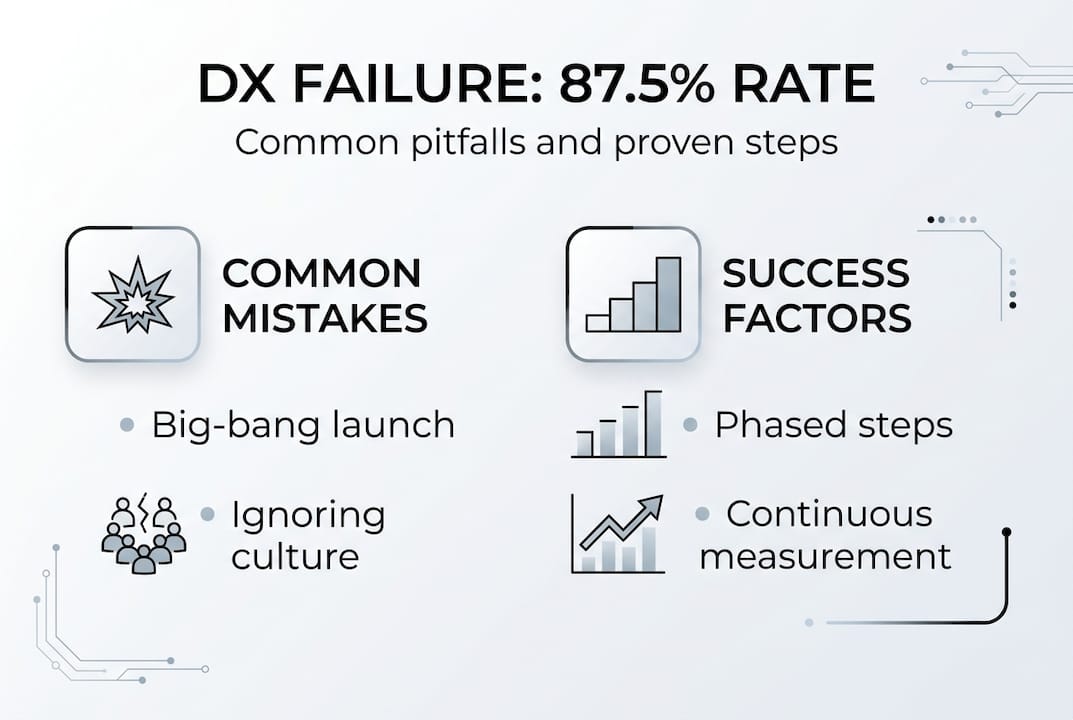
The traditional approach to digital transformation (DX) treats it like a construction project: plan everything upfront, build it all at once, and flip the switch. This big-bang model is where most organizations lose. The 87.5% failure rate for big-bang DX projects is not a technology problem. It is a strategy and culture problem.
Organizations that succeed treat transformation as a continuous process, not a one-time event. As continuous, people-first transformation replaces tech-hype-driven initiatives, the focus shifts from deploying tools to changing how people work. That shift is harder, but it is also far more durable.
The most common failure points include:
- Underestimating change management: Technology is rarely the bottleneck. People’s resistance to new workflows is.
- Lack of executive sponsorship: Without visible leadership commitment, adoption stalls at the middle-management layer.
- Scope creep in big-bang rollouts: Trying to transform everything simultaneously creates complexity that teams cannot absorb.
- Ignoring cultural readiness: Organizations that skip culture assessment see higher rollback rates and lower ROI.
- Treating DX as an IT project: When transformation is owned only by IT, business units disengage early.
“Digital transformation is not about technology. It is about people, processes, and the organizational will to change how value is created.”
For European enterprises, the DX steps for European enterprises that work consistently share one trait: they are phased, iterative, and anchored in measurable business outcomes rather than technology milestones.
With the urgency of transformation set, let’s clarify the core prerequisites you must address before launching a new initiative.
Prepare for successful digital transformation: prerequisites and readiness
Before you invest in platforms, vendors, or consultants, your organization needs an honest readiness assessment. Research shows that legacy resistance and talent gaps affect 90% of organizations attempting DX. Skipping this step is one of the most expensive mistakes a leadership team can make.

The five pillars of DX readiness provide a practical framework: data and analytics maturity, organizational culture, operational agility, employee engagement, and customer experience orientation. Score your organization honestly across each pillar before committing resources.
Organizational readiness checklist:
- Is your data infrastructure centralized and accessible across business units?
- Does leadership actively model the behaviors the transformation requires?
- Can your teams iterate quickly, or do approval cycles slow every decision?
- Are employees informed about the transformation goals and their role in them?
- Do you have a clear picture of current customer pain points that DX will address?
Pro Tip: Run a two-week internal survey across departments before your kickoff. Ask teams to rate their confidence in each of the five pillars on a scale of one to five. Gaps below three signal where you need to invest before technology deployment begins.
| Readiness pillar | Key metric | Target benchmark |
|---|---|---|
| Data and analytics | % of decisions driven by data | Above 60% |
| Culture | Change readiness score | Above 3.5 out of 5 |
| Agility | Average sprint cycle time | Under 3 weeks |
| Employee engagement | Transformation awareness rate | Above 80% |
| Customer experience | NPS tied to digital touchpoints | Positive and improving |
One often-overlooked edge case is legacy system modernization. Many enterprises assume they can layer new tools on top of old infrastructure. In practice, this creates technical debt that compounds over time. Addressing legacy systems early, even partially, reduces downstream friction significantly. The nearshoring benefits available through European talent pools can accelerate this modernization phase without the cost burden of onshore specialists.
If your organization meets these core readiness criteria, it is time to move to implementation strategies.
Step-by-step digital transformation process: phased implementation strategies
Phased implementation is not a compromise. It is the most effective way to manage risk while building organizational momentum. Here is a sequenced approach that works for medium and large enterprises:
- Define transformation scope and business outcomes: Identify two or three high-impact processes to transform first. Tie each to a measurable business outcome, not a technology deliverable.
- Launch AI and cloud pilots: 57% of B2B organizations are already running AI pilots. Start small, measure rigorously, and scale only what proves value.
- Apply agile at scale: Frameworks like SAFe (Scaled Agile Framework) and LeSS (Large-Scale Scrum) allow large teams to move with the speed of a startup. Agile methodologies speed order-to-cash cycles by 70 to 75%, a gain that directly impacts working capital.
- Integrate hybrid frameworks: Combine agile sprints with structured governance for compliance-heavy processes. This is especially relevant for European enterprises operating under GDPR and sector-specific regulations.
- Scale and optimize: Once pilots prove ROI, expand to adjacent processes. Use the data from early phases to refine your approach.
Pro Tip: Resist the urge to run more than three pilots simultaneously. Focus creates better data, faster learning, and cleaner scaling decisions.
| Methodology | Best for | Speed | Risk level |
|---|---|---|---|
| Big-bang | Greenfield startups | Fast upfront | Very high |
| Agile (SAFe, LeSS) | Large enterprises, iterative change | Steady | Low to medium |
| Hybrid | Regulated industries, complex legacy | Moderate | Medium |
For a detailed workflow on sequencing these steps, the DX steps and nearshoring strategy workflow resources provide practical templates that align with IMD strategies for 2026.
With your implementation approach structured, let’s explore the critical role nearshoring plays in European digital transformation success.
Nearshoring in Europe: maximizing efficiency, cost savings, and talent access
Nearshoring, the practice of relocating business functions to nearby countries rather than distant offshore locations, has become a strategic lever for European enterprises. The numbers are compelling. Nearshoring in Europe delivers 23 to 45% cost savings, improved cycle times, and access to deep talent pools across Central and Eastern Europe (CEE).
Beyond cost, nearshoring offers structural advantages that pure offshoring cannot match:
- Time zone alignment: CEE teams operate within one to three hours of Western European headquarters, enabling real-time collaboration.
- GDPR compliance: Nearshoring within the EU eliminates the data sovereignty risks associated with non-EU offshoring.
- Talent depth: Countries like Poland, Romania, and the Czech Republic produce tens of thousands of STEM graduates annually.
- Cultural proximity: Shared business norms and communication styles reduce the friction that offshoring risks often introduce.
| Factor | Nearshoring (CEE) | Offshoring (Asia/LatAm) |
|---|---|---|
| Cost savings | 23 to 45% | 40 to 60% |
| Time zone overlap | 1 to 3 hours | 6 to 12 hours |
| GDPR compliance | Full (EU-based) | Requires additional controls |
| Cultural alignment | High | Variable |
| Talent availability | Strong in STEM | Strong but competitive |
Pro Tip: When evaluating nearshoring partners, ask for case studies from organizations in your industry vertical. Generic cost savings claims are less useful than evidence of successful DX integration in comparable business environments.
The risks of nearshoring are real but manageable. Cultural alignment requires deliberate onboarding and communication protocols. Change management must extend to nearshore teams, not just headquarters. For a structured approach, the top nearshoring companies comparison and the nearshoring guide provide frameworks for partner selection and integration.
To evaluate your transformation’s impact, you will need a strong verification and measurement strategy.
Verification: measuring digital transformation outcomes and ROI
Measurement is where many DX initiatives lose credibility. Leaders invest in transformation, see activity, but cannot connect that activity to business outcomes. The solution is to define KPIs before implementation begins, not after.
For DX projects, the core metrics to track include:
- Operational efficiency: Reduction in process cycle times, error rates, and manual touchpoints.
- Cost savings: Direct cost reduction from automation, nearshoring, and process consolidation.
- Speed to delivery: Time from order to fulfillment, or from decision to deployment.
- Employee adoption rate: Percentage of target users actively using new systems after 90 days.
- Customer experience scores: NPS, CSAT, and resolution time improvements tied to digital touchpoints.
For nearshoring-specific KPIs, track cost per output unit, team ramp-up time, and quality scores against onshore benchmarks. AI and cloud integration combined with nearshoring consistently produces the highest DX ROI in European enterprise contexts.
Agile at scale and hybrid frameworks improve both efficiency and delivery speed, but only when measurement is built into the process from day one. Retrospectives, sprint reviews, and quarterly business reviews should all feed back into your KPI dashboard.
The outsourcing benefits of combining nearshoring with structured DX measurement are significant: organizations that track both operational and financial KPIs consistently outperform those that measure technology adoption alone.
With clear metrics in place, you are ready to leverage specialist resources for greater results.
Optimize digital transformation with expert nearshoring and outsourcing support
Executing a phased digital transformation while managing nearshoring integration is a significant operational challenge. Most enterprises benefit from specialist guidance, particularly when navigating legacy modernization, talent acquisition, and cross-border compliance.

StorsenDigital provides structured resources to support every stage of this journey. The nearshoring workflow guide offers a step-by-step process for achieving 23 to 45% cost savings through European nearshoring, while the outsourcing process guide covers the operational frameworks that keep transformation on track. Whether you are in the readiness assessment phase or scaling a proven pilot, expert business support can accelerate your timeline and reduce the risk of costly missteps. The difference between a stalled transformation and a successful one is often the quality of the strategic partnership behind it.
Frequently asked questions
What are the first steps for digital transformation in a medium or large enterprise?
Start with a readiness assessment focused on the five DX pillars: data, culture, agility, engagement, and customer experience. Score each pillar honestly before committing to technology investments.
How does nearshoring in Europe improve digital transformation outcomes?
Nearshoring delivers 23 to 45% cost savings alongside better time zone alignment, access to skilled STEM talent, and built-in GDPR compliance for technology projects.
What are the biggest mistakes to avoid in digital transformation?
Avoid the big-bang approach and underestimating culture and change management. The 87.5% failure rate for big-bang projects makes a strong case for phased, people-first methods.
How do you measure ROI in digital transformation projects?
Track operational efficiency, cost savings, speed to delivery, and business outcomes with clear KPIs set before implementation. Agile at scale improves both speed and efficiency when measurement is embedded from the start.
What are agile methodologies, and why are they recommended for DX?
Agile methodologies use iterative phases to pilot and scale technology changes, speeding order-to-cash cycles by 70 to 75% compared to traditional sequential approaches.


