


Jumping into outsourcing without strategic planning leads to costly miscommunications and scope creep that drain budgets and derail timelines. Medium to large European enterprises need a systematic approach to nearshoring that aligns vendor partnerships with business objectives, compliance requirements, and cultural fit. This guide equips decision makers with a proven framework to plan, execute, and monitor strategic outsourcing for measurable operational efficiency and cost savings.
Table of Contents
- Introduction To Strategic Outsourcing Planning
- Prerequisites: Readiness Assessment And Foundations
- Stepwise Strategic Outsourcing Implementation Framework
- Tailored Nearshoring Considerations For Europe
- Governance, Vendor Management, And Performance Monitoring
- Common Mistakes And Troubleshooting
- Expected Outcomes And Success Metrics
- Set Up Your Strategic Outsourcing With StorsenDigital
- FAQ
Key takeaways
| Point | Details |
|---|---|
| Strategic outsourcing requires readiness assessment and clear goal alignment | Companies with documented processes and governance structures achieve significantly higher partnership success rates. |
| Nearshoring in Europe demands cultural and regulatory compliance | Language compatibility, GDPR adherence, and local talent engagement are critical for European nearshoring effectiveness. |
| Strong governance and vendor management drive sustained value | Clear communication protocols, measurable KPIs, and regular performance reviews reduce risks and ensure accountability. |
| Avoid common pitfalls like skipping readiness checks | Treating outsourcing as procurement or neglecting performance tracking undermines strategic value and increases failure risk. |
| Expect 30 to 50 percent cost savings with strategic planning | Proper implementation delivers cost reductions, faster market delivery, and scalability within 3 to 6 month transition periods. |
Introduction to strategic outsourcing planning
Strategic outsourcing planning involves systematically aligning external vendor partnerships with core business objectives to achieve operational excellence, innovation, and competitive advantage. Unlike tactical outsourcing focused solely on cost cutting, strategic planning integrates vendor capabilities into long term business strategy. This approach transforms outsourcing from a transactional procurement activity into a value creating partnership.
The global outsourcing market demonstrates the strategic importance of this approach. Industry analysis projects market growth reaching $777 billion by 2028, driven by enterprises seeking agility, specialized expertise, and operational scalability. European businesses increasingly turn to nearshoring solutions to access regional talent pools while maintaining cultural alignment and regulatory compliance.
Strategic outsourcing delivers benefits beyond immediate cost savings:
- Access to specialized skills and emerging technologies without capital investment in training or infrastructure
- Operational flexibility to scale resources up or down based on market demands and project requirements
- Enhanced focus on core competencies by delegating non critical functions to expert vendors
- Accelerated innovation through partnerships with vendors bringing fresh perspectives and industry best practices
- Risk mitigation by distributing operational dependencies across geographically diverse partners
For medium to large enterprises, strategic planning ensures outsourcing partnerships align with business goals, regulatory requirements, and organizational culture. The outsourcing guide by Deloitte emphasizes that successful engagements require clear objectives, vendor alignment, and continuous performance management rather than reactive vendor selection.
Prerequisites: readiness assessment and foundations
Before engaging outsourcing partners, enterprises must establish foundational capabilities and organizational readiness. Research shows companies with well documented and standardized internal processes achieve significantly higher partnership success rates. Skipping this preparation phase leads to miscommunication, scope creep, and vendor misalignment.
Align business objectives with outsourcing goals by identifying which functions deliver strategic value internally versus those better handled by specialized vendors. Document current workflows, quality standards, and performance benchmarks to create clear handoff specifications. This groundwork prevents ambiguity and sets measurable expectations.
Key readiness prerequisites include:
- Clear articulation of business goals and how outsourcing supports strategic priorities like market expansion or digital transformation
- Comprehensive process documentation covering workflows, quality criteria, compliance requirements, and performance metrics
- Established governance structures defining decision authority, escalation paths, and vendor oversight responsibilities
- Performance management frameworks with baseline metrics to measure vendor contributions objectively
- Organizational mindset shift from viewing outsourcing as cost cutting to recognizing it as strategic partnership
- Budget allocation for transition costs, vendor management, and ongoing performance monitoring
European nearshoring introduces additional prerequisites around regulatory compliance and cultural fit. Familiarize your team with GDPR requirements, local labor laws, and cross border contractual considerations. Understanding these nuances prevents compliance issues and protects both parties. Review our nearshoring guide for European businesses for detailed regulatory frameworks and cultural alignment strategies.
Pro Tip: Create a readiness scorecard rating your organization across process maturity, governance capability, budget clarity, and stakeholder alignment. Address gaps scoring below 7 out of 10 before vendor selection to prevent costly rework. The outsourcing readiness checklist provides assessment frameworks you can customize.
Establishing these foundations positions your enterprise to select vendors based on strategic fit rather than price alone. Organizations demonstrating readiness achieve faster onboarding, clearer communication, and stronger vendor performance. Learn how nearshoring workflow and cost savings connect to operational readiness for European markets.
Stepwise strategic outsourcing implementation framework
Implementing strategic outsourcing requires a sequential framework balancing thorough planning with execution agility. Research confirms defining business objectives, project scope, and desired outcomes upfront prevents scope creep and vendor misalignment. Follow this proven methodology to execute outsourcing systematically.
Assess readiness and align objectives by conducting the organizational readiness evaluation described previously. Confirm leadership commitment, budget availability, and stakeholder buy in before proceeding.
Define scope, KPIs, and project requirements with precision. Document exactly which functions or processes you will outsource, quality standards expected, performance metrics for success, and timeline milestones. Clarity at this stage prevents expensive misunderstandings later.
Select and evaluate vendors based on strategic fit, not just cost. Assess vendor capabilities against your requirements, review references and case studies, evaluate cultural compatibility, and verify regulatory compliance credentials. For European nearshoring, prioritize vendors demonstrating GDPR expertise and regional market knowledge.
Establish governance and communication protocols defining decision making authority, escalation procedures, meeting cadences, and reporting requirements. Assign relationship owners on both sides and create communication channels for routine updates versus urgent issues.
Negotiate contracts and SLAs that balance flexibility with accountability. Include clear performance metrics, quality standards, pricing models, IP ownership terms, data security requirements, and exit provisions. European contracts should address cross border regulatory considerations.
Manage transition and knowledge transfer through structured onboarding. Provide comprehensive documentation, conduct training sessions, assign mentors, and plan for overlap periods where internal teams support vendor ramp up. Monitor closely during initial 90 days.
Monitor performance and optimize continuously by tracking KPIs, conducting regular reviews, soliciting feedback from both teams, and identifying improvement opportunities. Treat vendors as strategic partners who contribute to innovation and process enhancement.
Pro Tip: Build a 90 day transition roadmap with weekly milestones and checkpoints. This prevents the common mistake of assuming vendors will self direct immediately. Early investment in structure pays dividends through faster stabilization and stronger performance.
| Implementation Phase | Typical Duration | Key Deliverables |
|---|---|---|
| Readiness assessment | 2 to 4 weeks | Scorecard, stakeholder alignment, budget approval |
| Vendor selection | 4 to 8 weeks | RFP responses, vendor evaluations, final selection |
| Contract negotiation | 3 to 6 weeks | Signed agreements, SLAs, governance framework |
| Transition and onboarding | 8 to 12 weeks | Knowledge transfer, process documentation, initial performance baseline |
| Stabilization | 4 to 8 weeks | Performance optimization, issue resolution, continuous improvement |
This framework applies across outsourcing scenarios from IT services to finance operations to customer support. Customize timelines and governance complexity based on engagement scope and organizational size. The BPO outsourcing step-by-step guide provides function specific implementation details.
Successful implementation balances structure with flexibility. While following the framework systematically, remain responsive to vendor insights and market conditions. The strategic outsourcing project guide offers additional tactical recommendations for complex engagements.
Tailored nearshoring considerations for Europe
Nearshoring within Europe requires strategic adaptations addressing cultural compatibility, regulatory compliance, and talent engagement. Research demonstrates nearshoring partnerships in Europe require tailored strategies addressing language, cultural fit, regulatory frameworks, and flexible engagement models. These considerations differentiate successful European nearshoring from generic offshore approaches.

Cultural and language compatibility significantly impact communication effectiveness and collaboration quality. European nearshoring destinations offer linguistic diversity matching your business needs, from English fluency in Nordic and Baltic regions to German expertise in Central Europe. Select locations where vendor teams share cultural business norms around communication styles, decision making processes, and work expectations.
Regulatory and data compliance requirements demand careful attention when nearshoring in Europe. GDPR sets strict standards for data handling, privacy protection, and cross border transfers. Verify vendors maintain current compliance certifications and understand their data residency policies. Local labor laws, tax implications, and contractual enforceability vary across European jurisdictions, requiring legal expertise during vendor selection and contract negotiation.
Key European nearshoring considerations include:
- Language capabilities matching your customer base and internal stakeholder requirements for seamless collaboration
- Time zone alignment enabling real time communication and rapid response to business needs
- Cultural business practices around hierarchy, communication directness, and decision making authority
- GDPR compliance infrastructure including data processing agreements, security certifications, and audit capabilities
- Local talent pool depth and specialization in required technical or functional domains
- Political and economic stability providing partnership predictability and risk mitigation
- Flexible engagement models from dedicated teams to project based arrangements matching your scaling needs
European nearshoring destinations like Poland, Romania, Portugal, and the Baltic states offer compelling combinations of technical talent, cost efficiency, and regulatory alignment. Evaluate locations based on your specific requirements rather than generic market trends. The guide on setting up nearshoring Europe details country specific considerations and setup processes.
Leverage nearshoring flexibility through hybrid models combining onshore strategic oversight with nearshore execution capacity. This approach maintains close stakeholder engagement while accessing cost effective specialized talent. Review nearshoring strategy and cost savings frameworks for optimal resource allocation.
The outsourcing handbook by Deloitte emphasizes tailoring engagement models to specific business contexts rather than applying one size fits all approaches. European nearshoring success requires balancing standardized governance frameworks with localized operational adaptations.
Governance, vendor management, and performance monitoring
Effective governance structures and vendor management practices determine outsourcing partnership success. Studies show strong governance with defined communication and performance metrics reduces risks and drives accountability in outsourcing relationships. Without systematic oversight, even well planned engagements drift toward misalignment and underperformance.
Establish clear communication protocols defining regular touchpoints, reporting cadences, and escalation procedures. Weekly operational syncs address tactical issues, while monthly strategic reviews assess performance against objectives and identify improvement opportunities. Designate relationship owners with authority to make decisions and resolve conflicts quickly.
Performance monitoring requires measurable KPIs and SLAs aligned with business objectives. Define metrics covering quality, timeliness, cost efficiency, customer satisfaction, and strategic value contribution. Track leading indicators predicting future performance alongside lagging indicators measuring historical results. This balanced approach enables proactive intervention before issues escalate.
Key governance and management practices include:
- Structured meeting cadences with clear agendas, documented decisions, and action item tracking across operational and strategic levels
- Transparent performance dashboards providing real time visibility into KPI achievement, trend analysis, and variance explanations
- Formal escalation paths with defined response times and decision authority at each level from team leads to executive sponsors
- Regular relationship health assessments gathering feedback from both organizations on collaboration effectiveness and improvement opportunities
- Continuous improvement mechanisms encouraging vendor innovation, process optimization, and best practice sharing
- Risk management frameworks identifying potential issues early and implementing mitigation strategies proactively
Schedule quarterly business reviews examining strategic alignment, performance trends, market changes, and partnership evolution. These sessions provide forums for addressing systemic issues, celebrating successes, and planning capability enhancements. Treat vendors as partners invested in your success rather than transactional service providers.
Pro Tip: Implement a vendor scorecard balancing quantitative KPIs with qualitative collaboration assessments. Include metrics on responsiveness, innovation contribution, and problem solving alongside traditional quality and cost measures. This comprehensive view prevents optimizing narrow metrics while partnership health deteriorates.
The outsourcing process guide provides governance templates and meeting frameworks you can customize for your engagement. Strong governance transforms vendor relationships from reactive issue resolution to proactive value creation. The outsourcing best practices resource offers additional management strategies proven across industries.
Common mistakes and troubleshooting
Understanding frequent outsourcing pitfalls helps decision makers avoid costly mistakes and recover quickly when issues arise. Analysis reveals skipping readiness assessments often leads to communication breakdowns, scope creep, and quality issues. Learning from these common failures strengthens your strategic approach.
Skipping organizational readiness assessments represents the most damaging mistake. Enterprises rushing into vendor selection without process documentation, governance structures, or stakeholder alignment encounter preventable communication failures and expectation mismatches. The readiness gaps surface during onboarding when vendors lack clear direction and internal teams resist collaboration. Address this by completing the readiness scorecard before vendor engagement.
Treating outsourcing as procurement rather than strategic partnership severely limits value realization. Research confirms viewing outsourcing transactionally increases failure risk and prevents innovation contribution. When enterprises focus solely on cost reduction, they miss opportunities for process improvement, capability building, and competitive advantage. Shift mindset by involving vendors in strategic planning and soliciting improvement recommendations.
Poor communication and unclear expectations create scope ambiguity allowing creep that inflates costs and delays timelines. Without documented requirements, quality standards, and performance metrics, vendors interpret needs inconsistently leading to rework and frustration. Prevent this through comprehensive specifications, regular alignment checks, and transparent feedback loops.
Common outsourcing mistakes include:
- Selecting vendors based primarily on cost rather than strategic fit, capability depth, and cultural compatibility
- Insufficient knowledge transfer during transition leaving vendors without context to perform effectively
- Micromanaging vendor operations instead of focusing on outcomes and performance metrics
- Neglecting performance tracking and accountability mechanisms allowing drift from agreed standards
- Failing to invest in relationship building and collaborative problem solving
- Ignoring early warning signs like missed deadlines or quality dips until problems become crises
When issues arise, diagnose root causes systematically rather than reacting to symptoms. Communication breakdowns often stem from unclear requirements or inadequate governance rather than vendor incompetence. Quality problems may reflect insufficient training or unrealistic expectations versus capability gaps. Address systemic issues through process improvements and relationship investments.
Pro Tip: Conduct retrospectives after major milestones examining what worked well and what needs improvement. Create psychologically safe environments where both teams share honest feedback without blame. This continuous learning approach prevents recurring mistakes and strengthens partnership effectiveness.
The outsourcing readiness checklist helps identify vulnerability areas before they cause failures. Review outsourcing strategy 2026 Europe for region specific risk mitigation approaches.
Expected outcomes and success metrics
Strategic outsourcing delivers measurable business outcomes when planned and executed systematically. Understanding realistic expectations and success metrics helps enterprises evaluate vendor performance objectively and optimize partnership value. Set clear targets during planning to guide implementation and measure achievement.
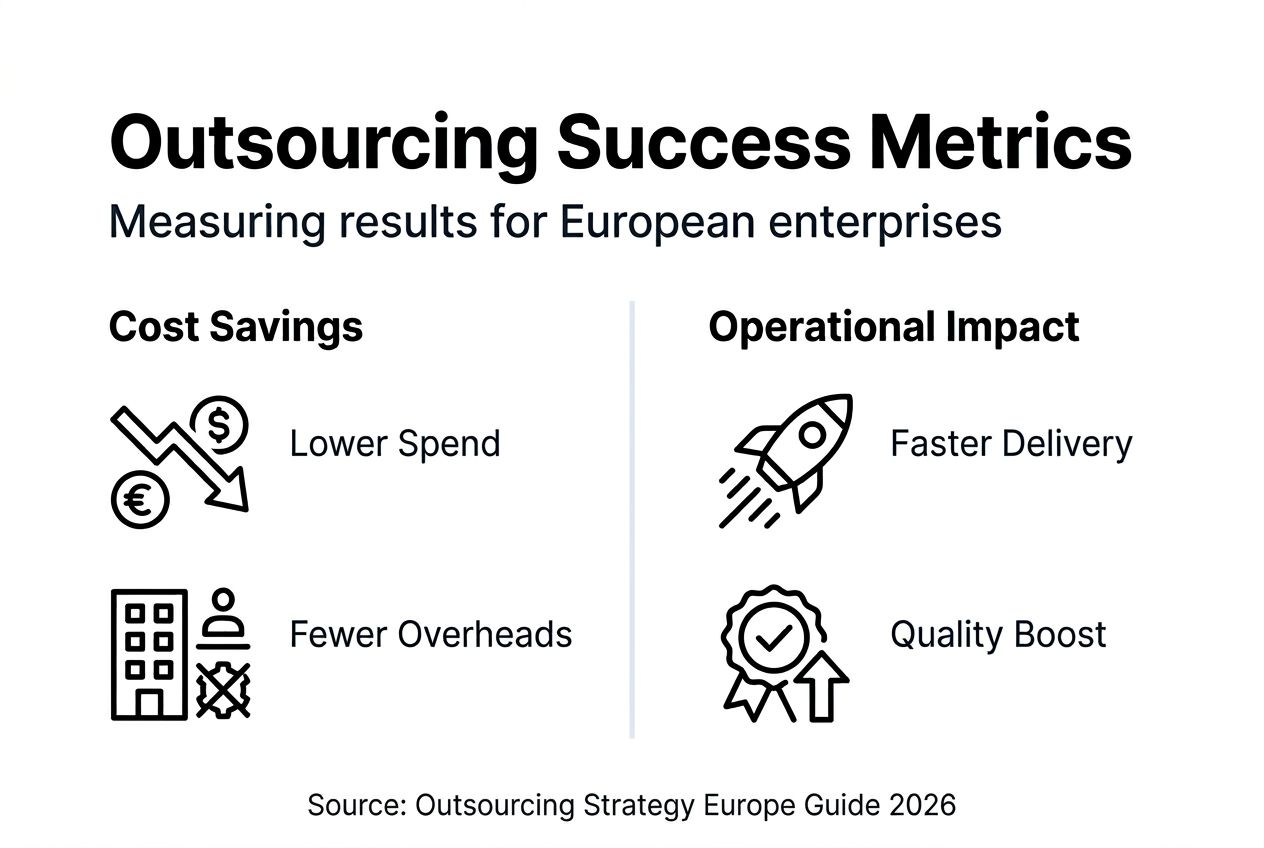
Cost savings represent the most immediate and visible outcome. Organizations typically achieve 30 to 50 percent cost reductions through strategic outsourcing and European nearshoring compared to maintaining equivalent internal capabilities. These savings result from labor cost differentials, operational efficiency improvements, and elimination of infrastructure investments. Calculate total cost of ownership including transition expenses and ongoing management overhead for accurate comparisons.
Performance improvements extend beyond cost to operational capabilities and strategic agility. Successful outsourcing partnerships accelerate time to market through access to specialized expertise and scalable capacity. Vendors bring industry best practices, proven methodologies, and technological capabilities that enhance quality and innovation. Measure improvements in cycle times, defect rates, customer satisfaction scores, and strategic initiative completion rates.
| Success Metric Category | Key Indicators | Typical Target Range |
|---|---|---|
| Cost efficiency | Total cost reduction, cost per transaction, ROI | 30 to 50 percent savings |
| Quality performance | Defect rates, rework percentage, compliance adherence | 95 to 99 percent accuracy |
| Operational speed | Cycle time reduction, time to market acceleration | 20 to 40 percent improvement |
| Scalability | Capacity flex time, resource ramp speed | 50 to 100 percent faster scaling |
| Strategic value | Innovation contributions, process improvements implemented | 3 to 5 major enhancements annually |
Vendor performance adherence to KPIs and SLAs provides ongoing success validation. Track metrics consistently from transition through steady state operations. Expect initial performance below targets during the first 30 to 60 days as vendors learn your requirements and processes. Performance should stabilize within 90 days and achieve full targets by month six.
Transition and stabilization periods typically span 3 to 6 months depending on engagement complexity and organizational readiness. Well prepared organizations with strong governance complete transitions faster with fewer disruptions. Plan for temporary performance dips during knowledge transfer as internal resources shift focus while vendors ramp capabilities.
Sustained value creation requires continuous improvement and partnership evolution. Mature outsourcing relationships deliver innovation beyond contracted services through vendor insights, technology adoption, and process optimization. Measure strategic value through business impact metrics like revenue growth enablement, market expansion support, and competitive advantage enhancement.
Learn how strategic planning connects to measurable outcomes in the outsourcing strategy 2026 Europe guide. Success requires balancing short term cost targets with long term strategic value creation through collaborative vendor partnerships.
Set up your strategic outsourcing with StorsenDigital
Ready to transform your outsourcing approach from tactical cost cutting to strategic value creation? StorsenDigital specializes in helping European enterprises plan, implement, and optimize nearshoring partnerships that deliver measurable efficiency gains and competitive advantages. Our experts guide you through readiness assessment, vendor selection, governance design, and performance optimization.

We bring deep expertise in European nearshoring markets, regulatory frameworks, and cultural dynamics that determine partnership success. Whether you are establishing your first nearshoring engagement or optimizing existing vendor relationships, our proven methodologies ensure strategic alignment and operational excellence. Leverage our comprehensive outsourcing process guide and nearshoring strategy workflow to accelerate your journey.
Discover the benefits of nearshoring and how StorsenDigital transforms outsourcing challenges into growth opportunities. Contact us to discuss your strategic outsourcing goals and develop a customized implementation roadmap.
FAQ
What is the most crucial prerequisite before starting strategic outsourcing?
Clear alignment between outsourcing goals and overall business strategy is essential. Companies must document current processes, establish governance structures, and secure stakeholder commitment before vendor selection. Organizations demonstrating readiness through process maturity and performance metrics achieve significantly higher partnership success rates.
How can European enterprises manage risks during nearshoring?
Establish strong governance protocols with defined communication channels, escalation paths, and performance monitoring frameworks. Incorporate thorough cultural and regulatory due diligence during vendor selection, verifying GDPR compliance, data security capabilities, and local legal expertise. Regular performance reviews and relationship health assessments enable proactive risk mitigation.
What are common pitfalls that cause outsourcing failure?
Skipping readiness assessments leads to communication breakdowns, scope creep, and quality issues from unclear requirements. Treating outsourcing as transactional procurement rather than strategic partnership limits innovation and value creation. Insufficient performance tracking and accountability mechanisms allow drift from agreed standards. Address these through comprehensive planning, clear governance, and continuous monitoring.
What cost savings and performance improvements can companies typically expect?
Strategic outsourcing and European nearshoring typically deliver 30 to 50 percent cost reductions compared to internal operations. Beyond cost savings, expect improved time to market, enhanced scalability, and access to specialized expertise. Transition periods usually complete within 3 to 6 months, with full performance targets achieved by month six. Sustained partnerships generate continuous improvement and innovation contributions.


