


Every unfilled vacancy costs your enterprise productivity, revenue, and competitive advantage. European businesses face intense talent competition, complex regulations, and rising operational costs that make traditional hiring painfully slow. Strategic sourcing offers a data-driven solution combining AI tools, hybrid recruitment models, and structured processes to slash hiring timelines by 40% while optimizing costs. This guide delivers actionable strategies tailored to European labor markets, helping you transform talent acquisition from a bottleneck into a strategic advantage.
Table of Contents
- Understanding The Strategic Sourcing Process
- Prerequisites: What You Need Before Starting
- Core Steps In The Strategic Sourcing Process
- Troubleshooting Common Mistakes
- Expected Outcomes And Success Metrics
- Additional Considerations And Alternative Approaches
- Explore Strategic Sourcing Solutions With StorsenDigital
- Frequently Asked Questions
Key takeaways
| Point | Details |
|---|---|
| Speed gains | Strategic sourcing reduces time to hire by up to 40% through AI and hybrid models. |
| Planning impact | Workforce planning prior to sourcing decreases unfilled roles by 25%. |
| Quality improvement | Structured interviews improve quality of hire by 15%. |
| Risk avoidance | Common sourcing mistakes can increase turnover by 30%. |
| Measurement necessity | Tracking KPIs ensures ongoing optimization of sourcing strategies. |
Understanding the strategic sourcing process
Strategic sourcing represents a data-driven, cyclical approach that integrates cost optimization with talent quality throughout your recruitment lifecycle. Unlike reactive hiring, this method combines workforce planning, AI-enhanced candidate discovery, hybrid recruitment models, and continuous performance measurement to build sustainable talent pipelines.
The European labor market presents unique challenges. You navigate varying regulations across countries, cultural diversity requiring adaptive approaches, and fierce competition for specialized skills. Strategic sourcing addresses these complexities by creating standardized yet flexible frameworks that respect local nuances while maintaining enterprise-wide efficiency.
This process connects multiple elements into a cohesive system. You begin with predictive workforce planning, leverage technology for candidate screening, deploy hybrid recruitment combining internal teams with external partners, and measure outcomes against defined KPIs. Each component reinforces the others, creating compounding improvements over time.
Key benefits include:
- Faster hiring cycles reducing vacancy-related productivity losses
- Lower recruitment costs through optimized resource allocation
- Improved candidate quality via structured assessment methods
- Better employee retention from enhanced cultural and skills fit
- Scalable processes that grow with your enterprise needs
Structured interviews combined with standardized scoring reduce hiring bias and improve quality of hire by 15%, demonstrating measurable impact on talent outcomes. For comprehensive context on European markets, explore our European talent acquisition guide or learn how to streamline your talent acquisition process with proven frameworks.
Prerequisites: what you need before starting
Successful strategic sourcing requires solid groundwork before you post a single job listing. Rushing into recruitment without preparation guarantees inefficiency, misaligned hires, and wasted resources.
Workforce planning forms your foundation. Conduct thorough skills gap analysis identifying current capabilities versus future needs across departments and geographies. Failing to plan workforce needs before sourcing leads to at least 25% more unfilled positions and delayed project launches, directly impacting revenue and market responsiveness.
Technology investments enable scale and speed. Prioritize these tools:
- AI-powered applicant tracking systems for automated screening and candidate matching
- Predictive analytics platforms forecasting hiring needs and identifying sourcing channels
- Collaboration software connecting hiring managers, recruiters, and compliance teams
- Assessment platforms delivering standardized candidate evaluations
| Technology Type | Primary Benefit | Implementation Timeline |
|---|---|---|
| AI-powered ATS | Screening efficiency | 4-6 weeks |
| Predictive analytics | Workforce forecasting | 6-8 weeks |
| Assessment platforms | Quality evaluation | 2-4 weeks |
| Collaboration tools | Stakeholder alignment | 1-2 weeks |
Stakeholder alignment prevents costly misunderstandings. Engage HR, finance, legal, and operational leaders early to establish shared definitions of success, budget parameters, and compliance requirements. European regulatory frameworks vary significantly by country, requiring input from local legal experts before launching recruitment campaigns.
Pro Tip: Create a cross-functional steering committee meeting biweekly during initial implementation to surface obstacles quickly and maintain momentum across departments.
For practical frameworks, review our efficient recruitment process guide covering preparation through onboarding.
Core steps in the strategic sourcing process
Executing strategic sourcing requires methodical progression through interconnected stages, each building on previous work to create cumulative improvements.
Conduct workforce need forecasting using predictive analytics examining historical hiring patterns, project pipelines, and attrition trends. Model scenarios for growth, contraction, and steady state to understand talent requirements across 12-18 month horizons.
Implement AI-powered ATS for candidate screening and rediscovery of past applicants who may now fit current roles. Configure algorithms to prioritize skills, experience, and cultural indicators aligned with your enterprise values, reducing manual resume review time by 60-70%.
Build a hybrid recruitment model balancing internal teams with external partners based on role complexity, volume, and urgency. Internal teams excel at cultural fit assessment and employer brand communication. External partners provide specialized expertise, geographic reach, and capacity flex during hiring surges.
| Model Type | Cost Efficiency | Speed | Cultural Fit | Best For |
|---|---|---|---|---|
| Internal only | Medium | Slow | Excellent | Strategic, leadership roles |
| Hybrid | High | Fast | Very good | Majority of positions |
| External only | Low | Very fast | Good | High-volume, specialized skills |
Develop candidate personas detailing ideal backgrounds, motivations, and career trajectories for key role categories. Target sourcing strategies to channels where these personas congregate, whether professional networks, industry events, or specialized job boards.
Use structured interviews with standardized scorecards evaluating candidates against identical criteria. Structured interviews combined with standardized scoring improve quality of hire by 15% while reducing unconscious bias that undermines diversity goals.
Continuously measure KPIs including time to hire, cost per hire, quality of hire scores, candidate satisfaction, and source effectiveness. Adjust sourcing strategies quarterly based on data, reallocating resources from underperforming channels to high-yield sources.
Pro Tip: Customize your hybrid sourcing balance by role urgency and volume rather than applying uniform ratios across all positions to maximize cost effectiveness.
Discover how predictive analytics in recruitment transforms strategic decision making through data-driven insights.
Troubleshooting common mistakes
Even well-intentioned strategic sourcing initiatives stumble over predictable pitfalls. Recognizing these errors early prevents expensive corrections later.
Skipping workforce planning tops the failure list. Organizations jumping directly to candidate sourcing without understanding future needs create mismatched hires, unfilled critical roles, and project delays. Common failures such as lack of workforce planning and poor use of AI lead to a 30% increase in turnover, destroying the efficiency gains strategic sourcing promises.
Underutilizing AI in candidate screening wastes your technology investment. Many enterprises implement advanced ATS platforms but continue manual resume screening because teams resist change or lack training. This negates speed advantages and burns recruiter time on low-value tasks.
Neglecting candidate experience throughout sourcing raises dropout rates and damages employer brand. Slow communication, confusing application processes, and disrespectful interview scheduling tell candidates you don’t value their time. Word spreads quickly in talent communities, making future sourcing harder.
Unclear hiring criteria harm candidate fit and retention. When hiring managers provide vague role descriptions or change requirements midstream, recruiters source wrong profiles and candidates accept positions misaligned with actual responsibilities. Turnover spikes within six months as reality disappoints expectations on both sides.
Pro Tip: Maintain transparent communication with candidates throughout every process stage, providing realistic timelines and prompt updates even when decisions take longer than planned to improve their experience and reduce dropouts.
Apply recruiting tips for faster hiring to avoid these common errors and accelerate your talent acquisition.
Expected outcomes and success metrics
Strategic sourcing delivers measurable improvements across multiple dimensions when implemented correctly. Defining success metrics before launch creates accountability and enables course correction.
Time to hire typically decreases 30-40% as AI screening, structured processes, and hybrid models eliminate bottlenecks. Roles that previously required 60-90 days to fill now close in 35-55 days, reducing vacancy costs and accelerating business initiatives.

Recruitment costs drop 25-30% through optimized channel allocation, reduced external recruiter dependence, and improved offer acceptance rates. Hybrid models particularly excel here, delivering external recruiter speed at internal team costs.
| Metric | Traditional Approach | Strategic Sourcing | Improvement |
|---|---|---|---|
| Time to hire | 75 days | 45 days | 40% reduction |
| Cost per hire | €8,500 | €6,000 | 29% reduction |
| Quality of hire score | 6.8/10 | 8.2/10 | 21% improvement |
| 12-month retention | 78% | 93% | 19% improvement |
Employee retention improves 20% with structured sourcing approaches emphasizing cultural fit and realistic job previews. Better matches reduce early turnover, preserving onboarding investments and maintaining team stability.
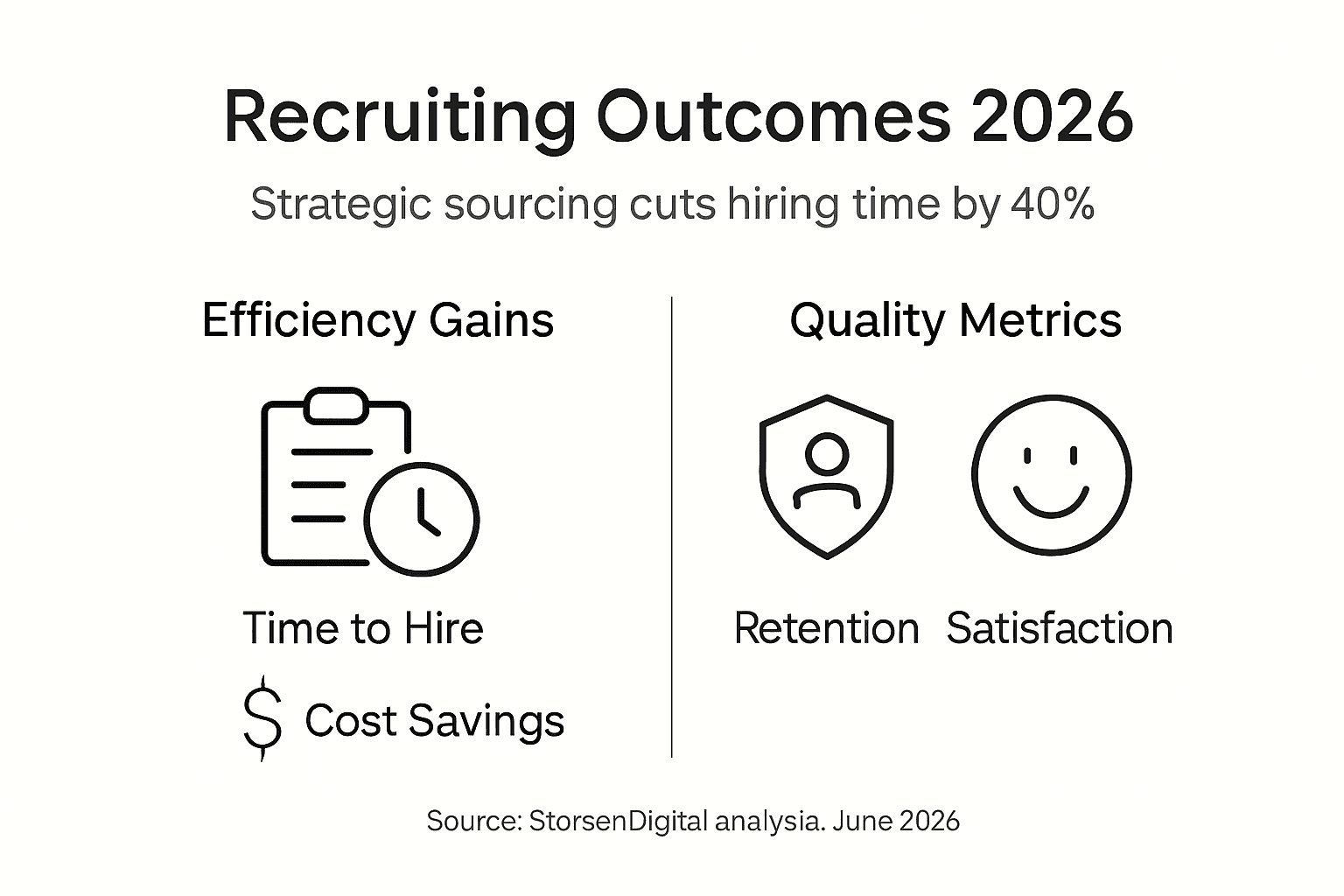
Quality of hire scores increase 15-20% using standardized assessments that evaluate candidates against objective criteria rather than interviewer gut feelings. These improvements compound over time as better hires strengthen teams and attract additional high performers.
Candidate satisfaction rates consistently surpass 80% when strategic sourcing includes experience optimization. Positive candidate experiences boost employer brand, encourage referrals, and reduce future sourcing costs.
ROI indicators extend beyond hiring metrics. Cost savings from hybrid models and efficiency gains with AI tools typically deliver 200-300% return on technology and process investments within 18-24 months. Compare your results against European outsourcing benchmarks 2026 to validate performance.
Additional considerations and alternative approaches
Strategic sourcing effectiveness depends on adapting to evolving work models and external factors shaping European labor markets.
Hybrid, remote, and flexible work models dramatically expand talent pools by removing geographic constraints. Offering location flexibility attracts candidates prioritizing work-life balance, particularly parents and caregivers underrepresented in traditional office-centric roles. Remote options also enable access to specialized skills concentrated in specific regions without requiring relocation.
European labor laws and cultural diversity impact sourcing strategies significantly. Employment regulations around contracts, working hours, termination, and benefits vary by country. Cultural preferences regarding communication styles, decision-making authority, and career development require tailored approaches. What works in Germany may fail in Spain or Poland.
Trade-offs between purely internal versus external or hybrid sourcing approaches merit careful analysis:
- Internal sourcing maximizes cultural fit but limits scale and specialized expertise
- External sourcing provides speed and specialization but reduces cultural alignment
- Hybrid approaches balance benefits but increase coordination complexity
AI enables continuous talent pool engagement and pipeline building beyond active recruitment. Relationship nurturing with passive candidates, automated talent community management, and predictive identification of future job seekers create always-on sourcing that reduces time to hire when roles open.
Explore broader context through our analysis of procurement trends in Europe influencing talent acquisition strategies.
Explore strategic sourcing solutions with StorsenDigital
Transforming talent acquisition requires expertise, technology, and proven methodologies. StorsenDigital brings comprehensive consulting and implementation services helping European enterprises optimize strategic sourcing from planning through execution.

Our team guides you through hybrid model design, AI tool selection and configuration, and compliance navigation across European jurisdictions. We’ve helped dozens of medium and large enterprises cut hiring timelines while improving candidate quality and reducing costs.
Whether you need full process redesign or targeted improvements, our tailored approach addresses your specific challenges. Review our outsourcing process guide or dive into our step-by-step recruitment process guide for detailed frameworks. Ready to start? Contact StorsenDigital today to discuss your talent acquisition goals.
Frequently asked questions
What is the strategic sourcing process and why is it important?
Strategic sourcing is a data-driven, cyclical approach optimizing talent acquisition through predictive planning, AI-enhanced screening, hybrid recruitment models, and continuous performance measurement. It addresses complex European hiring challenges including regulatory variation, talent competition, and cost pressures by creating standardized yet flexible frameworks. This method delivers faster hiring, lower costs, and improved candidate quality compared to reactive recruitment.
How do hybrid sourcing models reduce recruitment costs?
Hybrid models combine internal teams with external partners, providing broader talent access and faster onboarding at 40-70% lower cost than external-only approaches. Internal teams maintain cultural fit understanding while external partners deliver specialized expertise and capacity flex during hiring surges. This balance optimizes resource allocation, reducing dependence on expensive external recruiters while maintaining speed and quality.
What technology tools are essential for strategic sourcing?
AI-powered applicant tracking systems and predictive analytics platforms form the technology core. ATS automates candidate screening, matching, and past applicant rediscovery, reducing manual review time by 60-70%. Predictive analytics forecast hiring needs, identify effective sourcing channels, and model workforce scenarios. Assessment platforms and collaboration software complete the stack, enabling standardized evaluations and stakeholder alignment.
How can European labor market regulations impact sourcing strategies?
Varying regulations across European countries require tailored recruitment practices addressing local employment laws around contracts, working hours, termination, and benefits. Cultural diversity demands adaptive sourcing approaches respecting communication preferences, decision-making styles, and career development expectations. Non-compliance risks legal penalties, recruitment delays, and reputational damage. Engaging local legal experts during planning prevents costly mistakes and ensures sustainable sourcing strategies.


