


Over 60 percent of companies worldwide turn to IT outsourcing to keep up with rapid technology changes and rising costs. For many businesses, shifting tech responsibilities to external experts means access to global talent, faster innovation, and the freedom to concentrate on what they do best. Understanding the core principles, outsourcing models, and hidden risks is key if you want real advantages in a competitive market.
Table of Contents
- Defining IT Outsourcing And Core Concepts
- Major Types Of IT Outsourcing Models
- Key Benefits And Strategic Business Uses
- How The IT Outsourcing Process Works
- Risks, Challenges, And Cost Considerations
Key Takeaways
| Point | Details |
|---|---|
| Cost Efficiency | IT outsourcing helps organizations significantly reduce operational costs while accessing specialized skills. |
| Strategic Flexibility | Companies can choose from various outsourcing models (offshore, nearshore, onshore, hybrid) to align with their specific needs and objectives. |
| Risk Management | Effective outsourcing requires a robust framework to address operational, security, and compliance risks while ensuring quality control. |
| Innovation Catalyst | Partnering with external providers fosters technological innovation and enables businesses to pivot quickly in a competitive landscape. |
Defining IT Outsourcing and Core Concepts
IT Outsourcing represents a strategic business practice where companies engage external service providers to manage specific technological functions and processes that could traditionally be handled internally. According to Wikipedia, outsourcing involves contracting external providers to perform tasks while potentially transferring employees and assets to achieve operational efficiency.
At its core, IT outsourcing encompasses several critical dimensions. Companies typically pursue this strategy to accomplish multiple objectives:
- Reduce operational costs
- Access specialized technological expertise
- Enhance scalability and flexibility
- Focus internal resources on core business functions
- Mitigate technological implementation risks
The conceptual landscape of outsourcing extends beyond simple task delegation. Strategic outsourcing involves comprehensive partnerships where external providers become integral extensions of an organization’s technological infrastructure. By leveraging global talent pools and specialized service providers, businesses can transform potential operational challenges into competitive advantages.
Understanding outsourcing requires recognizing its nuanced approaches. Some organizations opt for complete outsourcing, where entire technological departments are managed externally, while others prefer selective outsourcing – targeting specific projects or technological domains. The research from arXiv suggests that modern outsourcing strategies represent complex transformational processes that extend traditional organizational boundaries, enabling businesses to reimagine their technological capabilities and strategic potential.
Major Types of IT Outsourcing Models
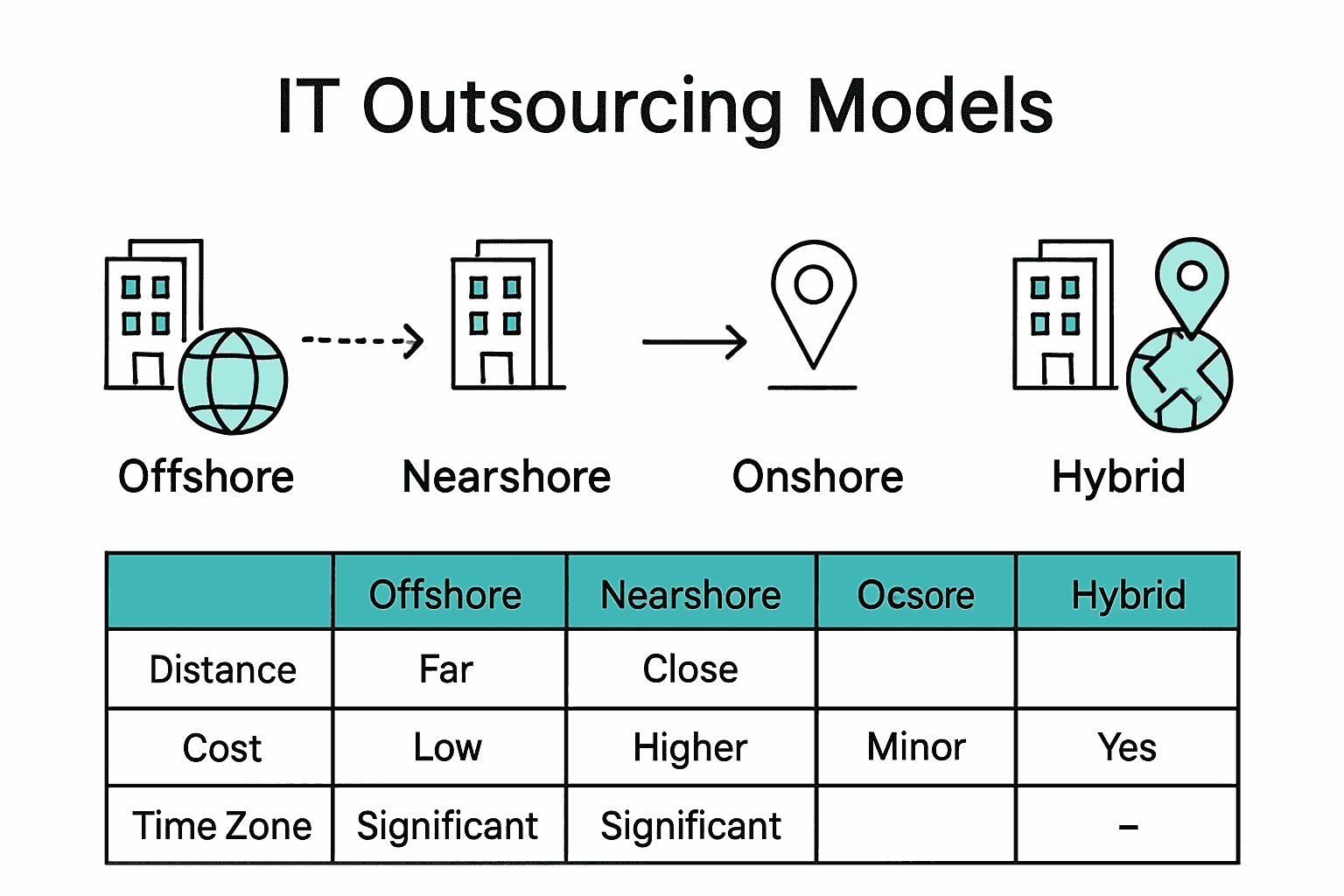
IT Outsourcing encompasses diverse models that enable businesses to strategically manage their technological resources and capabilities. These models represent sophisticated approaches to external service engagement, each offering unique advantages and addressing specific organizational needs.
The primary IT outsourcing models can be categorized into several key types:
Offshore Outsourcing
Offshore outsourcing involves engaging service providers located in geographically distant countries, typically where labor costs are significantly lower. Companies leverage this model to reduce expenses while accessing global talent pools. Regions like Eastern Europe, India, and Southeast Asia have become prominent offshore destinations for technological services.
Nearshore Outsourcing
Nearshore outsourcing represents a strategic approach where companies collaborate with service providers in neighboring or geographically close countries. This model offers advantages like minimal time zone differences, cultural similarities, and easier communication compared to offshore alternatives. European companies, for instance, might choose nearshore partners in Bosnia, Serbia, or other regional technology hubs.
Onshore Outsourcing
Onshore outsourcing involves partnering with service providers within the same national boundaries. This model prioritizes local talent, regulatory compliance, and direct communication. While potentially more expensive, onshore outsourcing provides greater control, easier collaboration, and reduced potential cultural or linguistic barriers.
Hybrid Outsourcing Models
Modern organizations increasingly adopt hybrid outsourcing strategies that combine multiple approaches. These flexible models allow businesses to optimize their technological resources by selecting specific components from different outsourcing types. A company might simultaneously employ offshore developers, nearshore project managers, and local consultants to create a comprehensive and adaptable technological ecosystem.
Choosing the right outsourcing model requires careful evaluation of organizational goals, budget constraints, technological requirements, and strategic long-term objectives. Successful implementation depends on understanding each model’s unique characteristics and aligning them with specific business needs.

Key Benefits and Strategic Business Uses
IT outsourcing represents a transformative strategy that enables businesses to unlock significant operational advantages and strategic capabilities. According to research from arXiv, strategic outsourcing can drive organizational change and foster innovation, positioning companies to achieve substantial competitive advantages in rapidly evolving technological landscapes.
The key benefits of IT outsourcing encompass multiple critical dimensions:
- Cost Optimization: Dramatic reduction in operational and infrastructure expenses
- Global Talent Access: Immediate connection to specialized technological expertise
- Scalability: Flexible resource allocation and rapid team expansion
- Focus Enhancement: Redirecting internal resources toward core business objectives
- Risk Mitigation: Leveraging external providers’ technological expertise and infrastructure
As Wikipedia highlights, outsourcing fundamentally enables organizations to concentrate on their primary competencies while externally managing complex technological requirements. This approach transforms traditional operational constraints into strategic opportunities, allowing businesses to maintain agility and responsiveness in dynamic market environments.
Strategic business uses of IT outsourcing extend beyond mere cost reduction. Modern enterprises utilize outsourcing as a sophisticated mechanism for technological innovation, talent acquisition, and organizational transformation. By partnering with specialized external providers, companies can rapidly implement cutting-edge technologies, access global talent pools, and create flexible organizational structures that adapt quickly to emerging market demands.
Successful IT outsourcing requires a nuanced approach that aligns external partnerships with internal strategic objectives. Organizations must carefully evaluate potential providers, establish clear communication protocols, and develop robust governance frameworks to maximize the potential of their outsourcing initiatives.
How the IT Outsourcing Process Works
The IT outsourcing process is a sophisticated, multi-stage strategic engagement that transforms how organizations manage technological resources and capabilities. According to Wikipedia, this process fundamentally involves contracting external providers to perform specific business functions, potentially including the transfer of employees and assets to achieve operational optimization.
The comprehensive IT outsourcing process typically unfolds through several critical stages:
- Strategic Assessment
- Identify internal technological gaps
- Define specific outsourcing objectives
- Evaluate current operational capabilities
- Determine desired outcomes and metrics
- Provider Selection
- Research potential service providers
- Conduct comprehensive vendor assessments
- Analyze technical competencies
- Review past performance and client testimonials
- Evaluate cultural and operational alignment
- Contract Negotiation
- Define precise service level agreements (SLAs)
- Establish clear performance expectations
- Determine pricing structures
- Outline intellectual property protections
- Create exit and transition strategies
Research from arXiv emphasizes the critical importance of inter-organizational coordination during the outsourcing process, particularly in managing potential technical faults and maintaining seamless operational continuity. This coordination requires establishing robust communication protocols, defining clear escalation mechanisms, and developing comprehensive fault management strategies.
The final stages of the IT outsourcing process involve continuous monitoring, performance evaluation, and iterative optimization. Successful outsourcing partnerships demand ongoing collaboration, transparent communication, and a willingness to adapt strategies based on emerging technological trends and organizational requirements. By implementing a structured, strategic approach, businesses can transform potential challenges into opportunities for technological innovation and operational excellence.
Risks, Challenges, and Cost Considerations
IT outsourcing, while offering substantial strategic advantages, presents a complex landscape of potential risks and challenges that organizations must carefully navigate. Research from arXiv emphasizes the critical importance of understanding and mitigating potential risks in transformational IT project management, highlighting the multifaceted nature of outsourcing decision-making.
The primary risks and challenges in IT outsourcing can be categorized into several critical domains:
Operational Risks
- Communication Barriers: Potential misunderstandings due to cultural or linguistic differences
- Quality Control: Maintaining consistent service standards across distributed teams
- Performance Inconsistency: Variability in delivery and technological capabilities
- Knowledge Transfer Complexities: Ensuring smooth information and expertise exchange
Security and Compliance Challenges
According to Wikipedia, outsourcing introduces significant concerns around data security and confidentiality. Organizations must implement rigorous risk mitigation strategies that include:
- Comprehensive data protection protocols
- Strict confidentiality agreements
- Regular security audits
- Advanced encryption mechanisms
- Compliance with international data protection regulations
Financial Considerations
Cost considerations extend far beyond initial price comparisons. Smart organizations evaluate the total cost of outsourcing, including:
- Direct Costs: Service provider fees
- Indirect Costs: Management overhead
- Transition Expenses: Initial setup and integration
- Potential Hidden Costs: Training, communication infrastructure, potential rework
Successful IT outsourcing demands a holistic approach that balances potential risks with strategic opportunities. Organizations must develop comprehensive risk management frameworks, maintain transparent communication channels, and remain adaptable to changing technological and operational landscapes. By proactively addressing potential challenges and implementing robust governance structures, businesses can transform outsourcing from a potential liability into a powerful strategic asset.
Unlock the Full Potential of IT Outsourcing with StorsenDigital
Navigating the complexities of IT outsourcing can be overwhelming especially when balancing cost, quality, and strategic goals. If you are facing challenges like finding the right outsourcing model, ensuring smooth knowledge transfer, or mitigating security risks, you are not alone. Many organizations struggle with coordinating offshore, nearshore, or onshore providers to maximize benefits such as cost optimization and access to global talent.
StorsenDigital specializes in tailored outsourcing and nearshoring solutions across Europe designed to overcome these exact challenges. With expertise in managed BPO, talent acquisition, and strategic consulting, we help you transform operational risks into growth opportunities. Explore our proven approach to scalable managed services that keep you focused on your core business while we handle the complexities of IT and business process outsourcing.

Ready to take control of your IT outsourcing journey and realize measurable advantages now Discover more about our comprehensive outsourcing and nearshoring services at StorsenDigital.com. Learn how you can improve collaboration, enhance scalability, and secure your operations with a trusted European partner. Visit us today to start your transformation toward cost-effective and innovative outsourcing strategies.
Explore our solutions here at StorsenDigital and begin crafting the future of your IT operations.
Frequently Asked Questions
What is IT Outsourcing?
IT outsourcing is a strategic business practice where companies engage external service providers to manage specific technological functions and processes, aiming for operational efficiency and cost reduction.
What are the main types of IT outsourcing models?
The main types of IT outsourcing models include offshore outsourcing, nearshore outsourcing, onshore outsourcing, and hybrid outsourcing models, each tailored to different organizational needs and goals.
What are the primary benefits of IT outsourcing?
Key benefits of IT outsourcing include cost optimization, access to global talent, scalability, enhanced focus on core business functions, and risk mitigation in technological implementation.
What stages are involved in the IT outsourcing process?
The IT outsourcing process involves several stages: strategic assessment, provider selection, contract negotiation, and continuous monitoring and optimization to ensure successful partnerships.


