


Over 56 percent of american companies are now choosing nearshoring to gain a competitive edge in global markets. This approach connects businesses with partners in nearby regions, making it easier to solve challenges like time zone gaps or cultural differences. Understanding the unique benefits and details of nearshoring helps american organizations tap into closer talent pools, streamline communication, and make smarter choices when planning for growth.
Table of Contents
- Defining Nearshoring In Outsourcing Strategies
- Types Of Nearshoring And Regional Variations
- Key Benefits And Core Characteristics
- Challenges, Risks, And Mitigation Strategies
- Financial Impact And Cost Comparison With Offshoring
- Choosing The Right Nearshoring Partner
Key Takeaways
| Point | Details |
|---|---|
| Strategic Advantage of Nearshoring | Nearshoring offers organizations the benefit of geographic proximity, facilitating real-time collaboration and minimizing communication barriers. |
| Diverse Types of Nearshoring | Various strategies such as technological, manufacturing, and R&D nearshoring cater to specific operational needs and regional dynamics. |
| Challenges and Mitigation | Companies should proactively address potential risks, including political instability and cultural alignment, through thorough assessments and training. |
| Financial Considerations | While nearshoring may have higher direct costs, it can lead to operational efficiencies and long-term savings through reduced communication barriers and travel costs. |
Defining Nearshoring in Outsourcing Strategies
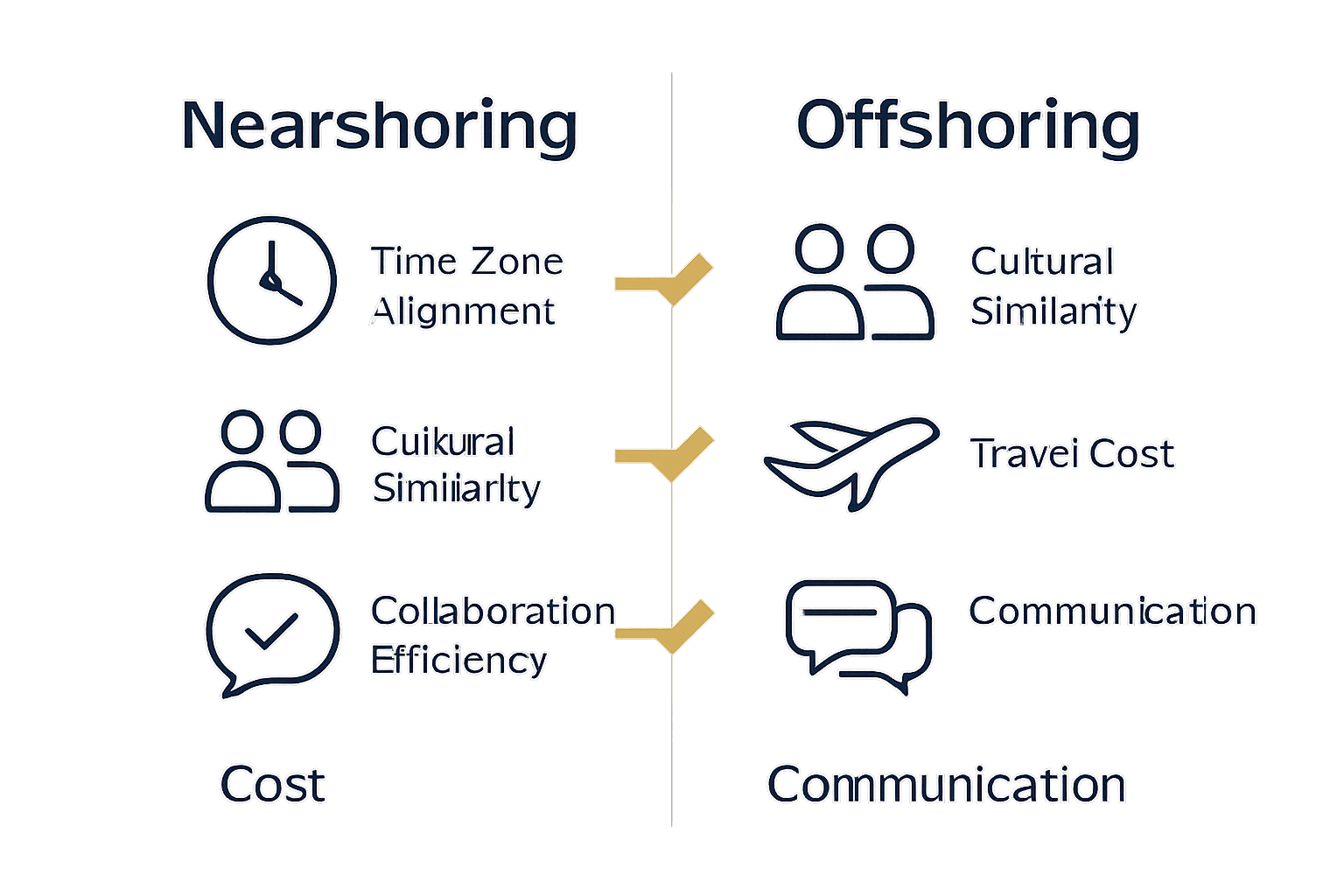
Nearshoring represents a strategic approach to outsourcing that enables businesses to collaborate with service providers in geographically close regions, offering unique advantages over traditional offshoring models. According to Wikipedia, nearshoring involves outsourcing business processes to companies in nearby countries, leveraging geographic, temporal, cultural, linguistic, and economic proximities as key strategic assets.
Nearshoring fundamentally transforms how organizations approach talent acquisition and operational expansion by prioritizing proximity and shared contextual understanding. Unlike traditional offshoring, which often involves working with teams thousands of miles away, nearshoring focuses on building partnerships with service providers in neighboring or closely aligned countries. This approach minimizes communication barriers, reduces travel complexity, and creates opportunities for more synchronized collaboration.
Key characteristics that define nearshoring include:
- Geographic proximity reducing travel time and costs
- Cultural and linguistic alignment
- Comparable time zones enabling real-time communication
- Similar regulatory and business environments
- Potential for faster knowledge transfer and smoother integration
For enterprise leaders seeking comprehensive insights into implementing nearshoring strategies, our guide on why use nearshoring provides an in-depth exploration of the strategic considerations and potential business impacts. By understanding these nuanced dynamics, organizations can make informed decisions about leveraging nearshoring as a powerful operational strategy.
Types of Nearshoring and Regional Variations
Nearshoring encompasses diverse strategies for relocating business operations, with distinct approaches tailored to specific organizational needs and regional dynamics. According to Open Access BCU Research, nearshoring represents a nuanced approach within offshoring where businesses strategically relocate operations to neighboring countries, differentiating itself from traditional farshoring models.
Regional Nearshoring Variations emerge across different geographical contexts, each presenting unique strategic advantages. In the European context, nearshoring often involves collaboration between countries with shared economic frameworks, such as within the European Union. North American enterprises frequently leverage nearshoring opportunities with neighboring countries like Mexico, while Asian businesses might focus on regional partnerships within Southeast Asian economic zones.
Key types of nearshoring include:
- Technological Nearshoring: Focusing on IT, software development, and digital service outsourcing
- Manufacturing Nearshoring: Relocating production facilities to nearby countries with competitive labor costs
- Service Sector Nearshoring: Outsourcing customer support, financial services, and administrative functions
- Research and Development Nearshoring: Establishing collaborative innovation centers in proximity
For enterprises considering strategic expansion through regional partnerships, our guide on setting up nearshoring for European expansion provides comprehensive insights into navigating the complex landscape of international business collaboration. Understanding these regional variations enables organizations to make informed decisions that align with their specific operational goals and market dynamics.

Key Benefits and Core Characteristics
Nearshoring offers enterprises a sophisticated strategic approach to talent acquisition and operational expansion, delivering numerous competitive advantages. According to DevsData, nearshore outsourcing provides critical benefits like cultural compatibility, access to top-tier talent, and an expanded talent pool, which significantly enhance collaboration and project outcomes.
Strategic Advantages of nearshoring extend far beyond traditional outsourcing models, creating unique opportunities for organizations seeking efficient and responsive business solutions. By prioritizing geographic proximity and shared cultural contexts, companies can develop more integrated, responsive, and agile operational frameworks. This approach minimizes communication barriers, reduces potential misunderstandings, and creates a more seamless collaborative environment compared to traditional offshore models.
Core characteristics and benefits of nearshoring include:
- Reduced communication complexity
- Similar time zone alignment
- Cultural and linguistic proximity
- Lower travel and operational coordination costs
- Faster project implementation cycles
- Enhanced intellectual property protection
- More robust talent accessibility
- Simplified legal and regulatory compliance
As businesses continue to navigate complex global markets, nearshoring emerges as a strategic solution that balances cost-efficiency with operational excellence. The ability to leverage nearby talent pools while maintaining high-quality standards represents a significant competitive advantage for forward-thinking enterprises seeking adaptive and responsive business strategies.
Challenges, Risks, and Mitigation Strategies
While nearshoring offers significant strategic advantages, organizations must carefully navigate potential challenges and risks inherent in cross-border business operations. According to University of Missouri, companies must comprehensively consider factors like political stability, labor costs, and overall business environment when deciding on nearshoring to effectively mitigate potential risks.
Risk Assessment becomes a critical component of successful nearshoring strategies. Open Access BCU Research highlights that nearshoring can present challenges such as cultural differences and potentially higher costs compared to traditional offshoring models. Enterprises must develop robust evaluation frameworks that go beyond surface-level analysis, diving deep into nuanced operational, economic, and cultural considerations.
Key challenges and corresponding mitigation strategies include:
- Political Instability: Conduct thorough geopolitical risk assessments
- Cultural Misalignment: Invest in cross-cultural training and communication protocols
- Compliance Complexity: Engage local legal experts and regulatory consultants
- Cost Management: Develop transparent pricing models and long-term financial projections
- Talent Quality: Implement rigorous recruitment and ongoing performance evaluation processes
- Communication Barriers: Establish clear communication frameworks and technology infrastructure
Successful nearshoring requires a proactive, strategic approach that anticipates potential challenges and develops comprehensive contingency plans. By maintaining flexibility, investing in relationship building, and maintaining transparent communication channels, enterprises can transform potential risks into opportunities for innovative collaboration and operational excellence.
Financial Impact and Cost Comparison With Offshoring
Navigating the financial landscape of outsourcing strategies requires a nuanced understanding of cost structures and potential value generation across different models. According to Open Access BCU Research, nearshoring may involve higher direct costs compared to traditional offshoring, but offers critical advantages like similar time zones and cultural alignment that can generate substantial operational efficiencies.
Cost Dynamics in nearshoring extend beyond simple labor rate comparisons, encompassing comprehensive financial considerations that impact long-term organizational performance. While offshoring traditionally offered the lowest upfront costs, nearshoring provides a more balanced approach that integrates economic efficiency with strategic operational benefits. The potential for reduced communication overhead, minimized travel expenses, and enhanced project collaboration can offset initial higher investment requirements.
Key financial considerations in nearshoring include:
- Lower indirect costs through reduced communication barriers
- Minimized travel and coordination expenses
- Reduced risk of project delays and miscommunication
- Enhanced intellectual property protection
- More predictable and stable labor markets
- Potential tax incentives and regional economic benefits
For enterprises seeking to optimize outsourcing costs for maximum ROI, understanding these nuanced financial implications becomes crucial. Nearshoring represents a strategic investment that balances immediate cost considerations with long-term operational effectiveness, offering a more sophisticated approach to global talent and resource management.
Choosing the Right Nearshoring Partner
Selecting an ideal nearshoring partner represents a critical strategic decision that can significantly impact an organization’s operational effectiveness and long-term success. According to TTEC, enterprises must carefully evaluate multiple factors including cultural alignment, language proficiency, and the partner’s technological infrastructure to ensure successful collaboration.
Partner Selection Criteria extend far beyond simple cost considerations, demanding a comprehensive assessment of potential collaborators’ capabilities, strategic compatibility, and operational maturity. Successful nearshoring partnerships require deep alignment in technical expertise, communication protocols, and shared business objectives. Organizations must conduct thorough due diligence, evaluating potential partners across multiple dimensions to guarantee seamless integration and sustained performance.
Key evaluation parameters for selecting a nearshoring partner include:
- Demonstrated technical competence and domain expertise
- Robust quality assurance and performance management processes
- Strong communication infrastructure and language capabilities
- Proven track record of successful international collaborations
- Cultural compatibility and shared professional values
- Scalable technological capabilities
- Transparent pricing and contractual frameworks
- Compliance with international regulatory standards
For enterprises exploring strategic outsourcing opportunities, our guide to outsourcing in business growth provides comprehensive insights into developing successful partnership strategies. Selecting the right nearshoring partner requires a nuanced, strategic approach that balances technical capabilities, cultural alignment, and long-term collaborative potential.
Unlock the Power of Nearshoring for Your Business Growth
Are you facing challenges with communication barriers or cultural misalignment in your outsourcing efforts? The “What Is Nearshoring? Complete Guide for Enterprises” article highlights key pain points such as the need for geographic proximity, shared time zones, and seamless operational integration. Nearshoring offers a strategic advantage by minimizing these obstacles while enhancing talent accessibility and accelerating project delivery.
At StorsenDigital.com, we specialize in tailored nearshoring solutions designed to help enterprises overcome these exact challenges. From talent recruitment and managed BPO services to strategic consulting and office establishment across Europe, our expertise transforms nearshoring opportunities into tangible business results. Benefit from cultural alignment, real-time communication, and cost-effective operational expansion by partnering with us.

Discover how to optimize your outsourcing strategy with expert guidance and scalable services. Visit our homepage to explore our comprehensive offerings. Ready to expand your enterprise with the right nearshoring partner? Take the next step today and access our outsourcing business growth guide for actionable insights.
Connect with us now to turn nearshoring challenges into your competitive edge.
Frequently Asked Questions
What is nearshoring?
Nearshoring is a strategic approach to outsourcing where businesses partner with service providers in geographically close regions, leveraging advantages like reduced travel costs, cultural similarities, and aligned time zones for more effective collaboration.
What are the benefits of nearshoring compared to offshoring?
Nearshoring offers several benefits over offshoring, including reduced communication complexities, similar time zones, cultural and linguistic alignment, lower travel costs, and faster project implementation cycles, enhancing overall operational efficiency.
What are the key challenges associated with nearshoring?
Key challenges of nearshoring include political instability, cultural misalignment, compliance complexities, and potential higher costs compared to traditional offshoring. Addressing these challenges requires strategic evaluation and risk assessment.
How can enterprises choose the right nearshoring partner?
Enterprises should evaluate potential nearshoring partners based on their technical competence, communication infrastructure, cultural compatibility, and proven track record of successful collaborations to ensure effective and seamless integration.


