


Every American business leader faces tough choices about efficiency and growth. With more than 50 percent of global organizations now using business process outsourcing, understanding how BPO providers operate becomes crucial. Knowing the types, benefits, and potential security risks of modern BPO solutions empowers American companies to compete globally, reduce costs, and access expertise without growing in-house teams beyond their limits.
Table of Contents
- Defining BPO Providers And Core Functions
- Major Types Of BPO Solutions Explained
- Crucial Benefits For European Enterprises
- Risks, Security, And Compliance Factors
- Cost Efficiency Versus In-House Teams
Key Takeaways
| Point | Details |
|---|---|
| Strategic Focus on Core Competencies | BPO allows companies to concentrate on core functions by outsourcing non-core tasks to specialized providers. |
| Diverse BPO Solutions | BPO encompasses back-office and front-office services, enabling tailored outsourcing strategies that align with unique business needs. |
| Access to Global Talent | Engaging BPO providers opens avenues for accessing specialized expertise and advanced technological capabilities without extensive internal investments. |
| Risk Management Necessity | Effective risk management frameworks are essential for BPO engagements to ensure data security, regulatory compliance, and operational flexibility. |
Defining BPO Providers and Core Functions
Business Process Outsourcing (BPO) represents a strategic approach where organizations contract specialized external providers to manage specific non-core business functions. According to IBM’s comprehensive definition, BPO enables companies to focus on their primary competencies while delegating critical but peripheral tasks to expert service providers.
At its core, BPO encompasses a wide range of operational processes including customer support, human resources, finance, accounting, and technology services. These providers are not simply temporary staffing solutions, but sophisticated partners who bring specialized expertise, advanced technological infrastructure, and proven methodological approaches to complex business challenges. Organizations leverage BPO to achieve multiple strategic objectives: reducing operational costs, accessing global talent pools, improving process efficiency, and maintaining competitive flexibility in rapidly changing market environments.
The fundamental value proposition of BPO providers centers on their ability to transform business processes through specialized knowledge and technological capabilities. By implementing structured operational frameworks, these providers help enterprises optimize performance, scale operations more effectively, and redirect internal resources toward core strategic initiatives. Modern BPO services extend far beyond traditional outsourcing models, offering integrated solutions that combine human expertise with advanced technological platforms.
Pro Tip: Strategic Selection Approach: Conduct a comprehensive internal audit of your business processes before engaging a BPO provider to precisely identify which functions would benefit most from external management and optimization.
Major Types of BPO Solutions Explained
According to comprehensive research on business process outsourcing, BPO solutions can be strategically categorized into two primary domains: back-office and front-office functions. These distinct categories represent different operational approaches that enable businesses to optimize their organizational efficiency and focus on core strategic objectives.
Back-office BPO solutions encompass critical internal processes that do not directly interact with customers but are essential for organizational functionality. These typically include finance and accounting services, human resources management, data processing, compliance documentation, and administrative support. Front-office BPO solutions, conversely, focus on customer-facing interactions and include services like technical support, customer service centers, sales support, and marketing communication management. Modern BPO providers offer specialized solutions tailored to various business needs, enabling companies to leverage external expertise across multiple operational domains.
The diversity of BPO solutions allows organizations to create customized outsourcing strategies that align precisely with their unique business requirements. Some prominent BPO service categories include knowledge process outsourcing (KPO), which involves high-value analytical and research-based tasks, and information technology outsourcing (ITO), focusing on technological infrastructure and digital service management. These specialized solutions provide businesses with flexible approaches to managing complex operational challenges, reducing costs, and accessing global talent pools with advanced technological capabilities.
Here’s a summary comparing key types of BPO solutions and their core focus:
| BPO Type | Main Activities | Primary Business Impact |
|---|---|---|
| Back-Office | Finance, accounting, HR, data processing | Improves efficiency, reduces cost |
| Front-Office | Customer support, sales, marketing | Enhances customer engagement |
| Knowledge Process Outsourcing (KPO) | Research, analytics, specialized expertise | Drives innovation, informed decisions |
| IT Outsourcing (ITO) | Technical support, infrastructure management | Enables digital transformation |
Pro Tip: Strategic Evaluation Approach: Conduct a comprehensive internal process audit to identify which specific BPO solutions would deliver the most significant operational improvements and cost efficiencies for your organization.
Crucial Benefits for European Enterprises
Strategic BPO adoption enables European enterprises to dramatically transform their operational capabilities, offering a comprehensive approach to navigating increasingly complex business environments. By strategically outsourcing non-core functions, organizations can redirect critical internal resources towards innovation, strategic planning, and core business development, ultimately enhancing their competitive positioning in global markets.

The primary benefits of BPO for European enterprises extend far beyond simple cost reduction. Process integration strategies play a pivotal role in enhancing overall firm performance, enabling companies to achieve unprecedented levels of operational efficiency and strategic agility. Key advantages include accessing specialized global talent, reducing operational overhead, accelerating technological adoption, and creating more flexible organizational structures that can rapidly adapt to changing market dynamics.
European enterprises particularly benefit from BPO’s ability to provide scalable solutions across diverse operational domains. By leveraging external expertise in areas such as finance, human resources, customer support, and technological infrastructure, companies can implement advanced capabilities without substantial internal investment. This approach allows businesses to maintain lean organizational structures while simultaneously accessing world-class capabilities, driving innovation, and maintaining competitive edge in increasingly complex and fast-evolving global business landscapes.
Pro Tip: Strategic Alignment Approach: Conduct a comprehensive internal capabilities assessment to identify precise BPO opportunities that align perfectly with your organization’s strategic growth objectives and operational requirements.
Risks, Security, and Compliance Factors
Contemporary research highlights critical challenges in business process outsourcing that demand comprehensive risk management strategies, emphasizing the need for organizations to develop robust frameworks addressing data security, regulatory compliance, and ethical considerations. The complexity of modern outsourcing environments requires businesses to implement multifaceted approaches that protect sensitive information while maintaining operational flexibility.
Data security emerges as a paramount concern in BPO engagements, with potential vulnerabilities spanning technological infrastructure, human interactions, and regulatory landscapes. Cloud-based BPO systems introduce additional complexity in maintaining comprehensive monitoring and protection mechanisms, necessitating advanced technological solutions and rigorous compliance protocols. Key risk areas include unauthorized data access, potential breaches of confidential information, potential misalignment with international regulatory standards, and challenges in maintaining consistent quality control across distributed operational environments.
Effective risk mitigation in BPO requires a holistic approach that integrates technological safeguards, comprehensive legal frameworks, and continuous monitoring systems. Organizations must prioritize selecting BPO partners with demonstrated capabilities in data protection, regulatory compliance, and transparent operational practices. This involves conducting thorough due diligence, implementing robust contractual agreements, establishing clear communication protocols, and developing comprehensive incident response strategies that can rapidly address potential security challenges.
Pro Tip: Security Assessment Strategy: Develop a comprehensive vendor risk assessment matrix that evaluates potential BPO partners across multiple dimensions, including technological infrastructure, compliance history, data protection protocols, and demonstrated commitment to ethical business practices.
Cost Efficiency Versus In-House Teams
Business process outsourcing offers a transformative approach to converting traditional fixed operational costs into more flexible and strategic financial models, enabling organizations to achieve unprecedented levels of cost efficiency and operational agility. By strategically shifting non-core functions to specialized external providers, companies can significantly reduce overhead expenses associated with maintaining comprehensive in-house teams, while simultaneously accessing advanced technological capabilities and specialized expertise.
Comprehensive research demonstrates that outsourcing non-core activities can generate substantial economic advantages, allowing businesses to reallocate financial resources towards core strategic initiatives. The cost benefits extend beyond mere monetary savings, encompassing reduced recruitment expenses, lower training investments, minimized infrastructure requirements, and enhanced scalability. In-house teams typically involve substantial fixed costs including salaries, benefits, equipment, workspace, ongoing training, and technological infrastructure, whereas BPO providers distribute these expenses across multiple clients, creating a more economically efficient model.
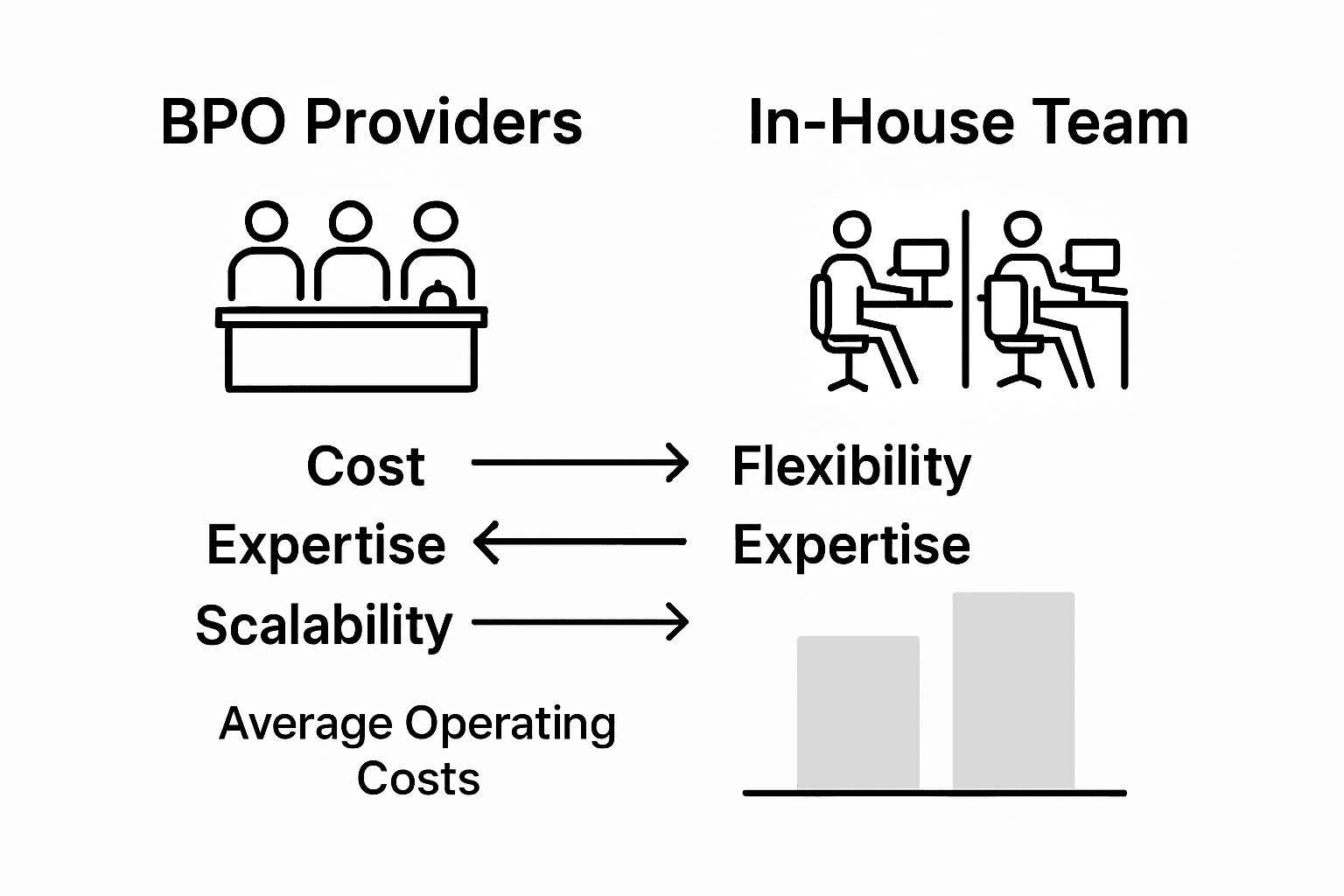
The financial comparison between in-house teams and BPO solutions reveals nuanced considerations beyond simple cost calculations. While in-house teams offer direct control and potentially deeper institutional knowledge, they require significant ongoing investment in talent development, technological upgrades, and operational maintenance. BPO providers, conversely, bring specialized expertise, state-of-the-art technological infrastructure, and the ability to rapidly scale operations without corresponding increases in fixed organizational expenses. This approach enables businesses to maintain lean organizational structures while accessing world-class capabilities, effectively transforming potential operational limitations into strategic competitive advantages.
Below is a concise comparison of in-house teams versus BPO providers on critical business dimensions:
| Dimension | In-House Teams | BPO Providers |
|---|---|---|
| Cost Structure | High fixed costs | Flexible, lower fixed costs |
| Scalability | Slower, resource intensive | Rapid, on-demand scaling |
| Expertise Access | Limited by location | Global talent pool |
| Technological Investment | Requires large capital | Included in service fees |
| Process Flexibility | Less agile | Highly adaptive |
Pro Tip: Cost Comparison Strategy: Conduct a comprehensive total cost of ownership analysis that includes not just direct expenses, but also indirect costs like training, technological infrastructure, recruitment, and potential productivity gains when evaluating BPO versus in-house team investments.
Unlock Business Growth with Expert BPO Solutions Tailored for European Enterprises
The article highlights the critical challenges businesses face in selecting the right BPO providers to achieve operational efficiency, cost reduction, and scalability. If you are navigating complex decisions around outsourcing key functions such as HR, finance, IT, or customer support, you understand the pain points of needing specialized expertise while maintaining data security and compliance. At StorsenDigital, we recognize these challenges and offer comprehensive managed BPO services designed to seamlessly integrate with your strategic goals. Our solutions empower your company to harness the power of nearshoring, transform fixed costs into flexible investments, and unlock the full potential of European talent and digital infrastructure.
Experience peace of mind knowing you have a strategic partner that prioritizes security, compliance, and outstanding process optimization. Whether you are looking to scale rapidly or enhance customer engagement through front-office support, our team brings proven methodologies and customized approaches to your business growth journey.
Explore how our tailored services can help you capitalize on the benefits of BPO and outperform competitors worldwide.
Elevate your outsourcing strategy today with StorsenDigital’s Contact Page and discover expert consulting that drives real results.

Ready to transform your business by leveraging specialized BPO expertise? Connect with us now at StorsenDigital Contact and take the first step toward scalable growth and operational excellence. Learn more about our approach to Managed BPO Solutions and how we can design a strategy uniquely suited to your needs.
Frequently Asked Questions
What are the main benefits of choosing BPO providers for business growth?
BPO providers help organizations reduce operational costs, access specialized global talent, improve process efficiency, and maintain competitive flexibility. Outsourcing non-core functions enables companies to focus on their primary competencies and drive innovation in their core business areas.
How do BPO solutions differ between back-office and front-office functions?
Back-office BPO focuses on internal processes such as finance, HR, and data processing, enhancing operational efficiency. Front-office BPO, on the other hand, involves customer-facing services like customer support and sales, which aim to enhance customer engagement and satisfaction.
What should organizations consider when selecting a BPO provider?
When choosing a BPO provider, organizations should conduct thorough due diligence on the provider’s technological capabilities, compliance history, data protection protocols, and overall reputation. Conducting a comprehensive internal audit of business processes can help identify which functions would benefit most from outsourcing.
How can organizations ensure data security and compliance when using BPO services?
To ensure data security and compliance, organizations should prioritize BPO partners with strong data protection measures, clear legal frameworks, and robust incident response strategies. Implementing comprehensive vendor risk assessments can also help evaluate potential partners on critical security aspects.


