


Most American companies are rethinking how they handle outsourcing, with over 60 percent now considering nearshoring as a smarter option. As global competition intensifies, finding reliable ways to cut expenses without sacrificing collaboration is more important than ever. Nearshoring offers a practical solution by connecting American businesses with nearby talent, fostering closer partnerships and better communication while still delivering major cost savings.
Table of Contents
- Defining Nearshoring In Modern Outsourcing
- Common Nearshoring Models And Variations
- Key Business Benefits Of Nearshoring
- Comparing Nearshoring Vs. Offshoring And Onshoring
- Risk Factors And How To Mitigate Them
Key Takeaways
| Point | Details |
|---|---|
| Strategic Outsourcing Model | Nearshoring focuses on geographical and cultural proximity, enhancing operational collaboration compared to offshoring. |
| Cost Efficiency | Businesses can reduce operational expenses by 30-50% while accessing skilled talent in nearby countries. |
| Enhanced Communication | Similar time zones and cultural contexts minimize communication barriers, leading to more effective teamwork. |
| Flexibility and Control | Nearshoring allows companies to quickly scale operations and maintain tighter oversight over outsourced processes. |
Defining Nearshoring in Modern Outsourcing
Nearshoring represents a strategic business approach where companies outsource processes or services to neighboring countries, offering significant advantages over traditional offshoring models. Unlike global outsourcing that might involve distant regions, nearshoring focuses on geographical and cultural proximity to create more effective operational partnerships.
At its core, nearshoring involves shifting business tasks or entire operational segments to countries close to the organization’s primary location, typically sharing similar time zones, cultural understanding, and economic environments. This approach allows businesses to leverage cost efficiencies while maintaining closer collaboration and communication compared to traditional outsourcing strategies. Companies can access skilled talent pools, reduce operational expenses, and minimize potential communication barriers that often plague more distant outsourcing arrangements.
The strategic benefits of nearshoring extend beyond simple cost reduction. By choosing geographically proximate partners, organizations can significantly improve project oversight, reduce travel complexities, and create more integrated teams. Nearshoring enables companies to maintain closer control over outsourced processes while benefiting from competitive labor markets and specialized talent pools. This approach represents a nuanced evolution in global business strategy, balancing economic optimization with operational excellence.
Common Nearshoring Models and Variations
Nearshoring encompasses several strategic models that enable businesses to optimize their operational efficiency by leveraging proximate international talent pools. Nearshoring strategies typically fall into three primary variations, each designed to address specific organizational needs and operational requirements.
The first model, Regional Proximity Nearshoring, focuses on partnering with countries in the same geographic region that share similar cultural and economic characteristics. This approach minimizes communication barriers and allows for more seamless collaboration. Companies often choose this model when seeking talent pools with comparable work standards, language capabilities, and professional infrastructures. For instance, European companies might nearshore to Eastern European countries, while North American businesses might engage with Latin American talent centers.
A second prominent model is the Specialized Skill Nearshoring approach, which prioritizes accessing specific technical or professional expertise that might be challenging to find domestically. This variation goes beyond simple cost reduction, targeting regions known for strong educational systems and specialized talent concentrations. Technology firms, for example, might nearshore software development to countries with robust engineering education systems and a proven track record of producing high-caliber technical professionals. Business process outsourcing scalability becomes significantly more achievable through this targeted talent acquisition strategy.
The third model, Hybrid Nearshoring, represents a more flexible approach that combines elements of regional proximity and specialized skill acquisition. Organizations using this model might distribute different operational components across multiple nearby countries, optimizing for both cost efficiency and specific skill requirements. This dynamic model allows businesses to create complex, adaptable outsourcing ecosystems that can rapidly respond to changing market demands and technological shifts.
Key Business Benefits of Nearshoring
Businesses increasingly recognize nearshoring as a strategic approach that delivers substantial competitive advantages across multiple operational dimensions. Outsourcing strategies for business growth have evolved to prioritize proximity-based models that offer more than traditional cost-cutting approaches.

The primary business benefits of nearshoring center on three critical areas: cost efficiency, communication effectiveness, and talent accessibility. Cost advantages emerge from lower labor expenses in nearby countries without sacrificing quality, creating a compelling economic model. Companies can reduce operational expenses by 30-50% while maintaining high professional standards. Communication barriers diminish significantly when working with teams in similar time zones and cultural contexts, enabling more responsive and collaborative work environments.
Talent acquisition represents another profound benefit of nearshoring. European expansion strategies increasingly leverage nearshoring to access specialized skill pools that might be constrained or expensive in domestic markets. Technical professionals in nearshore locations often possess advanced educational backgrounds and specialized training, allowing businesses to recruit top-tier talent without the complexities of global relocation or extensive international hiring processes.
Moreover, nearshoring provides strategic flexibility that traditional outsourcing models cannot match. Organizations can rapidly scale operations, pivot quickly to changing market demands, and maintain tighter control over outsourced processes. The proximity allows for more frequent in-person interactions, deeper collaboration, and a more integrated approach to international team management. Businesses gain the ability to create agile, responsive operational models that transcend traditional geographical limitations while maintaining high standards of quality and efficiency.
Comparing Nearshoring vs. Offshoring and Onshoring
Outsourcing strategies have evolved to offer businesses multiple approaches for managing operational resources. BPO services provide companies with different models of geographical workforce distribution, each presenting unique advantages and challenges.
Nearshoring distinguishes itself from traditional offshoring by prioritizing geographical and cultural proximity. Offshoring typically involves relocating business processes to distant countries, often across continents, which can introduce significant communication challenges and cultural disconnects. In contrast, nearshoring focuses on partnering with countries in close geographical proximity, sharing similar time zones, cultural nuances, and often more aligned professional standards. This approach reduces potential friction points that emerge in long-distance international collaborations.
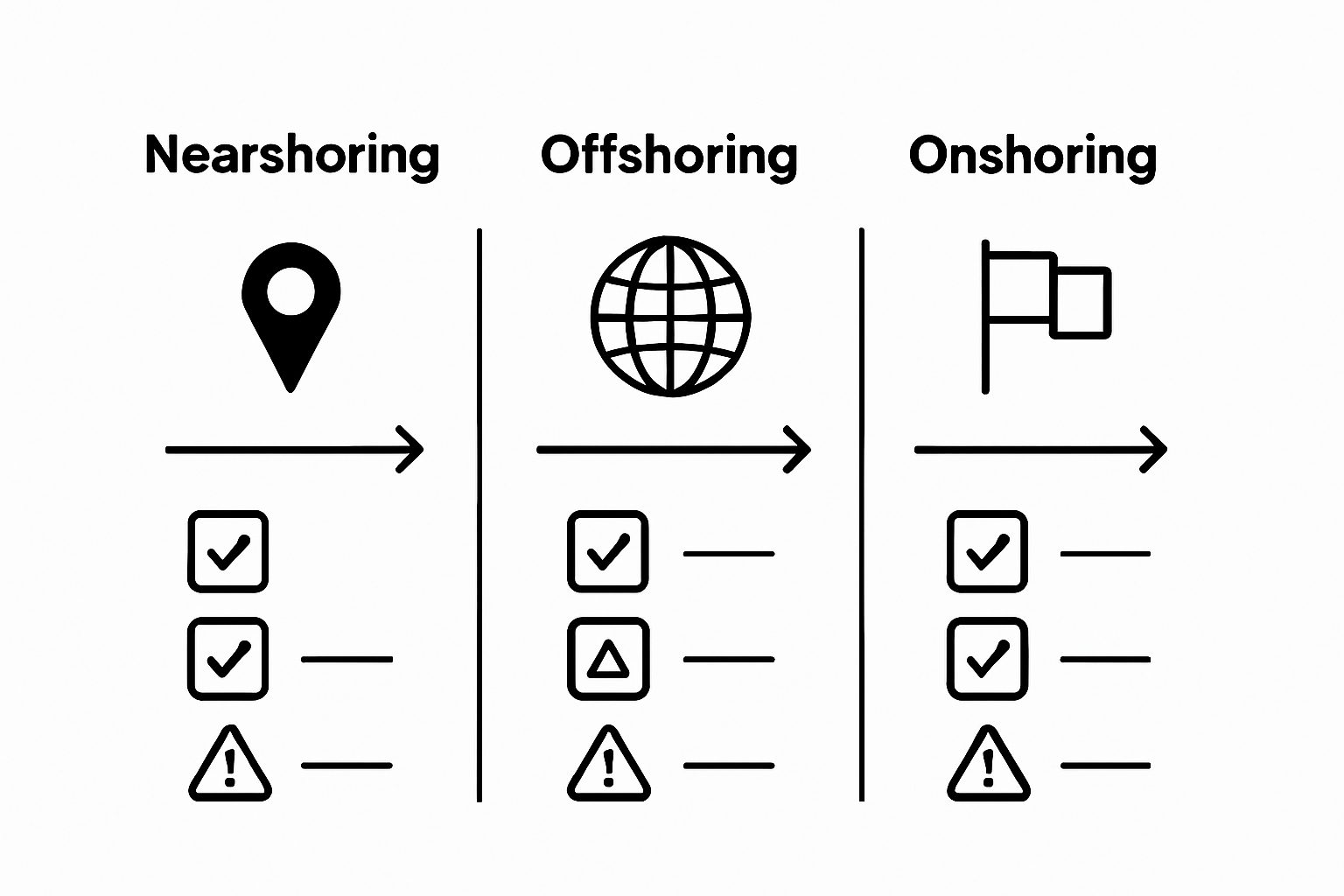
Onshoring represents the most localized strategy, where companies maintain all operations within their home country’s borders. While onshoring provides maximum regulatory compliance and minimal cultural barriers, it often comes with substantially higher operational costs. Nearshoring offers a strategic middle ground, delivering cost efficiencies similar to offshoring while maintaining many of the collaborative advantages of onshoring. Companies can access specialized talent pools, reduce communication complexities, and achieve significant cost savings without sacrificing operational quality or team integration.
The choice between nearshoring, offshoring, and onshoring ultimately depends on an organization’s specific strategic objectives, budget constraints, and operational requirements. Nearshoring emerges as a particularly compelling option for businesses seeking a balanced approach that combines cost-effectiveness, talent accessibility, and operational flexibility. By carefully evaluating the unique characteristics of each outsourcing model, companies can design more sophisticated, responsive, and efficient global workforce strategies.
Risk Factors and How to Mitigate Them
Nearshoring, while offering significant strategic advantages, introduces a complex landscape of potential risks that require strategic management and proactive planning. Outsourcing business growth strategies must incorporate comprehensive risk mitigation frameworks to ensure successful international collaborations.
The primary risk factors in nearshoring span several critical domains: communication challenges, legal compliance, data security, and operational continuity. Communication barriers can be systematically addressed through targeted cultural training programs, establishing clear communication protocols, and investing in robust technological infrastructure that enables seamless cross-border collaboration. Organizations should prioritize developing shared communication standards, utilizing collaborative platforms that support real-time translation, and conducting periodic cultural competency workshops to bridge potential understanding gaps.
Legal and regulatory risks represent another significant consideration in nearshoring initiatives. Companies must conduct thorough due diligence on potential nearshore partners, examining their compliance frameworks, intellectual property protection mechanisms, and data privacy standards. This involves comprehensive contract negotiations, establishing clear performance metrics, and developing contingency plans that outline specific remediation processes in case of potential contractual breaches. Technical teams should perform rigorous security audits, implement multi-layered encryption protocols, and create detailed data protection agreements that exceed standard international regulatory requirements.
Operational continuity risks can be mitigated through strategic redundancy planning and flexible workforce management approaches. Successful nearshoring requires developing backup talent pools, creating cross-training programs, and establishing agile operational models that can quickly adapt to potential disruptions. By maintaining a holistic view of potential challenges and implementing proactive risk management strategies, businesses can transform potential nearshoring risks into opportunities for enhanced operational resilience and strategic growth.
Unlock Cost Savings and Top Talent with Expert Nearshoring Support
The article highlights the challenge many businesses face when balancing cost efficiency, talent acquisition, and operational speed in outsourcing decisions. If you are struggling with how to optimize your outsourced operations while maintaining high-quality communication and quick project turnaround, nearshoring is a smart strategy to consider. This approach simplifies collaboration by working with geographically and culturally close partners, significantly reducing risks common in distant offshoring.
At StorsenDigital, we specialize in delivering comprehensive nearshoring solutions tailored for medium to large enterprises aiming to leverage European talent and digital infrastructure. Our expertise spans from talent recruitment and office setup to managed BPO services in HR, finance, IT, customer support, and software development. We understand the pressure to reduce costs without sacrificing quality or control. Partner with us to experience operational excellence, faster project delivery, and scalable business growth.
Ready to harness the true potential of nearshoring for your company?

Explore how our strategic outsourcing and nearshoring services can transform your business today by visiting StorsenDigital.com. Take control of your operational efficiency and gain a competitive edge now.
Frequently Asked Questions
What are the advantages of nearshoring over traditional offshoring?
Nearshoring offers advantages such as reduced communication barriers, cultural alignment, and the ability to maintain closer oversight of operations. Additionally, it often results in cost savings without sacrificing quality.
How does nearshoring help in accessing specialized talent?
Nearshoring allows companies to tap into talent pools that possess specific skills or expertise that may be scarce or expensive domestically. This is particularly beneficial for industries requiring specialized knowledge or advanced technical skills.
What should businesses consider when choosing nearshoring partners?
Businesses should evaluate the partner’s legal compliance, communication skills, cultural compatibility, and talent availability. Conducting thorough due diligence ensures that the partnership aligns with the company’s operational goals and standards.
How can companies mitigate risks associated with nearshoring?
To mitigate risks, companies should implement clear communication protocols, conduct security audits, and establish contingency plans for operational continuity. Training programs and legal due diligence are crucial for ensuring successful collaborations.


