


Most industry leaders agree that over 60 percent of major European companies now rely on outsourcing, a trend that is transforming the way organizations operate. As American and European businesses look to stay competitive, understanding the nuances between traditional outsourcing and nearshoring becomes crucial. This overview sheds light on their defining characteristics, showing how smart choices can lead to cost savings, specialized talent access, and greater agility for modern enterprises.
Table of Contents
- Defining Outsourcing and Nearshoring in Europe
- Major Outsourcing Models and Distinct Advantages
- Key Benefits: Scalability, Cost, and Talent Access
- Legal, Compliance, and Data Protection Essentials
- Strategic Risks and Choosing the Right Partner
Key Takeaways
| Point | Details |
|---|---|
| Outsourcing vs. Nearshoring | Outsourcing involves delegating tasks to external providers, while nearshoring focuses on providers in nearby countries, enhancing collaboration and reducing logistical issues. |
| Outsourcing Models | Businesses can leverage various models like onshoring, nearshoring, offshoring, and multisourcing to optimize efficiency and risk management. |
| Benefits of European Outsourcing | Key advantages include scalability, cost-efficiency, and access to a diverse talent pool with specialized skills that drive innovation. |
| Legal and Compliance Aspects | Companies must navigate strict legal frameworks and GDPR regulations while ensuring robust data protection and compliance strategies. |
Defining Outsourcing and Nearshoring in Europe
Outsourcing represents a strategic business approach where companies delegate specific tasks or processes to external service providers, typically to optimize operational efficiency and reduce costs. In the European context, outsourcing has evolved into a nuanced practice that goes beyond simple cost reduction, focusing on accessing specialized talent and strategic capabilities.
Nearshoring, a specific subset of outsourcing, emerges as a strategic alternative that involves partnering with service providers in geographically proximate countries. Unlike traditional offshoring, which might involve distant locations with significant cultural and time zone differences, nearshoring in Europe enables businesses to collaborate with partners in neighboring or regional countries. This approach offers multiple advantages:
- Reduced communication barriers
- Similar time zones
- Closer cultural alignment
- More streamlined travel for in-person collaboration
- Potentially lower transportation and logistical costs
The key distinction between outsourcing and nearshoring lies in geographic proximity and strategic intent. While outsourcing can occur globally, nearshoring specifically targets providers within a relatively close geographical region. For European enterprises, this often means working with professionals in Eastern or Southeastern European countries that offer robust technical expertise, competitive pricing, and cultural compatibility. Understanding the nuanced approach to nearshoring allows companies to make more informed decisions about their operational strategies, balancing cost-effectiveness with strategic growth objectives.

Major Outsourcing Models and Distinct Advantages
Businesses today leverage multiple outsourcing models to optimize operational efficiency and strategic capabilities. The primary models include onshoring, nearshoring, offshoring, and multisourcing, each offering unique advantages tailored to specific organizational needs and strategic objectives.
Onshoring models involve contracting service providers within the same country, which minimizes cultural and communication barriers while maintaining domestic economic support. Nearshoring, by contrast, involves partnering with service providers in neighboring or geographically close countries, offering benefits like:
- Reduced communication complexities
- Similar time zones
- Cultural proximity
- More affordable labor costs
- Easier travel and collaboration
Offshoring represents a global approach where companies engage service providers in distant countries, often prioritizing significant cost reductions. Multisourcing emerges as a sophisticated strategy where organizations distribute tasks across multiple providers, creating a diversified and resilient service ecosystem. This model allows businesses to mitigate risks, leverage specialized expertise, and maintain flexibility in their operational strategies. Business process outsourcing services have increasingly adopted these nuanced models, recognizing that modern outsourcing extends far beyond simple cost-cutting measures to become a strategic tool for global competitiveness and innovation.
Key Benefits: Scalability, Cost, and Talent Access
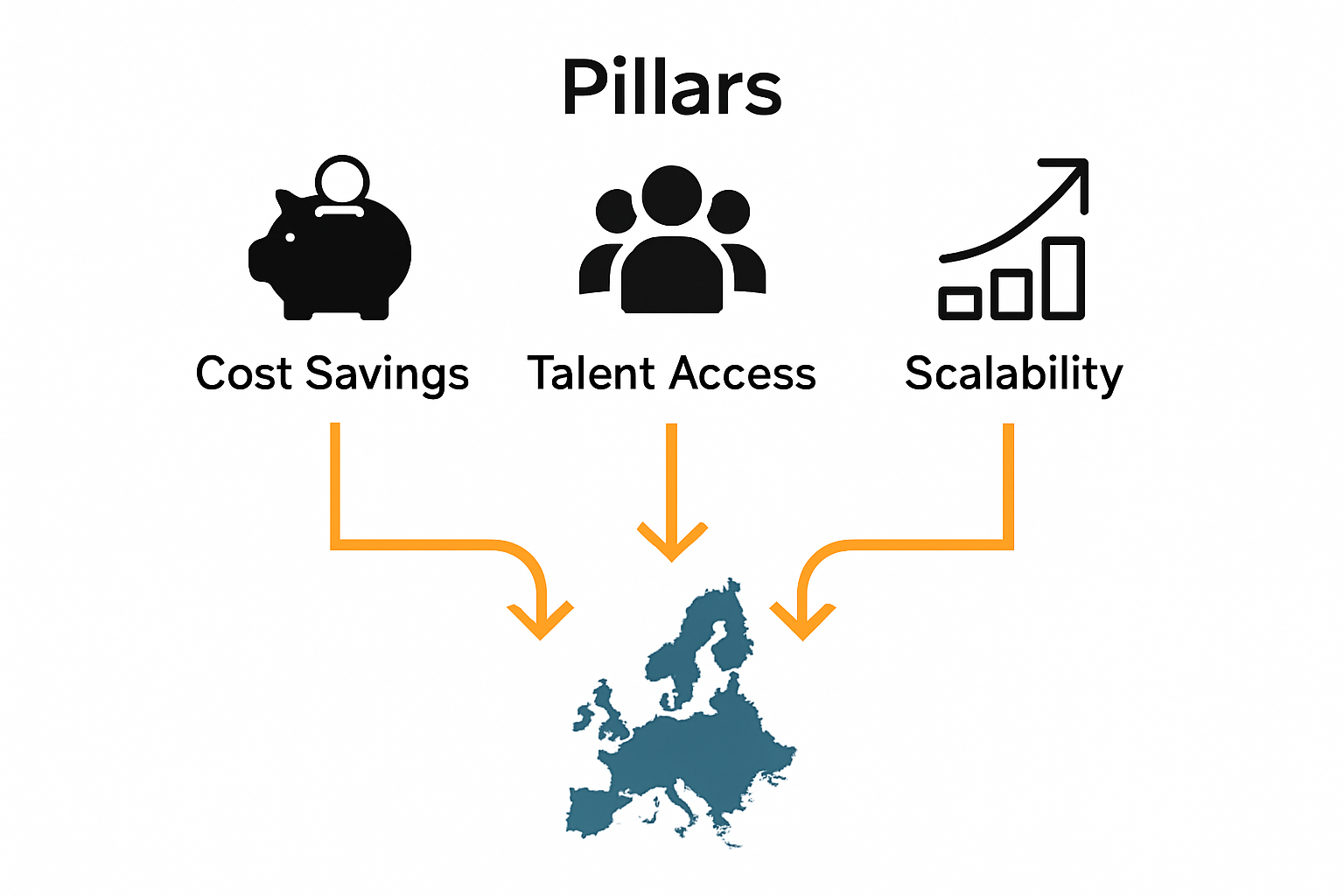
Outsourcing in Europe offers transformative benefits for businesses seeking strategic growth and operational optimization. Scalability emerges as a primary advantage, enabling companies to rapidly adjust their workforce and capabilities without the substantial overhead of traditional hiring processes. How to improve business process outsourcing scalability demonstrates that flexible staffing models allow organizations to quickly ramp up or down based on market demands, project requirements, and economic conditions.
Cost efficiency represents another critical benefit of European outsourcing strategies. Companies can significantly reduce operational expenses by accessing talented professionals at substantially lower rates compared to maintaining full-time internal teams. The cost advantages extend beyond simple wage arbitrage and encompass:
- Reduced infrastructure investments
- Lower recruitment and training expenses
- Minimized administrative overhead
- Flexible resource allocation
- Elimination of long-term employment commitments
Talent access stands as the most compelling advantage of European outsourcing. The continent boasts a rich pool of highly educated, multilingual professionals with advanced technical skills across numerous industries. Modern outsourcing strategies enable businesses to tap into specialized expertise that might be challenging or expensive to develop internally. By strategically leveraging European talent markets, organizations can build dynamic, skilled teams that drive innovation and competitive advantage without the traditional constraints of geographic and organizational boundaries.
Legal, Compliance, and Data Protection Essentials
Navigating the legal landscape of European outsourcing requires a sophisticated understanding of complex regulatory frameworks. Data protection stands at the forefront of these considerations, with the European Union’s General Data Protection Regulation (GDPR) establishing rigorous standards for handling personal and corporate information. Companies must implement comprehensive legal compliance strategies that prioritize data security, privacy, and transparent information management practices.
Key legal compliance requirements for organizations engaging in European outsourcing include:
- Comprehensive data protection agreements
- Explicit consent mechanisms
- Robust cybersecurity protocols
- Transparent data handling processes
- Regular compliance audits
- Clear contractual liability definitions
- Strict access control measures
Moreover, organizations must carefully evaluate the legal implications of cross-border data transfers, intellectual property protection, and contractual obligations. Outsourcing agreements must meticulously define jurisdictional responsibilities, confidentiality terms, and dispute resolution mechanisms. The complexity of these legal frameworks demands a proactive approach, with businesses needing to develop sophisticated governance models that balance operational flexibility with stringent regulatory compliance. Successful European outsourcing strategies recognize that legal preparedness is not merely a checkbox exercise but a critical component of strategic risk management.
Strategic Risks and Choosing the Right Partner
Strategic partner selection represents a critical determinant of outsourcing success, requiring meticulous evaluation beyond surface-level cost considerations. Technology-driven partner assessment has transformed the partner selection landscape, enabling more sophisticated due diligence processes that encompass technological capabilities, cultural alignment, and long-term strategic compatibility.
Key strategic risks companies must evaluate include:
- Potential communication breakdowns
- Intellectual property vulnerabilities
- Technology infrastructure misalignment
- Operational performance inconsistencies
- Compliance and regulatory divergences
- Cultural and operational friction points
- Potential hidden transition costs
Companies must develop a comprehensive partner evaluation framework that goes beyond traditional metrics. Offshoring research networks suggest conducting thorough assessments that include technical capabilities, financial stability, talent pool depth, innovation potential, and adaptability to changing business environments. Successful partnerships are built on transparent communication, aligned strategic objectives, and a mutual commitment to continuous improvement and technological evolution.
Unlock Your European Outsourcing Potential With StorsenDigital
Navigating the complexities of outsourcing in Europe requires more than just understanding cost advantages and legal compliance. The article highlights key challenges such as finding the right talent, ensuring strategic partner alignment, and managing data protection under GDPR regulations. If your business seeks scalable solutions that blend expert nearshoring with robust operational support, you need a partner who turns these challenges into strategic benefits.
StorsenDigital.com specializes in delivering tailored outsourcing, nearshoring, and business process outsourcing services designed for medium to large enterprises aiming to optimize costs and access top European talent. Our comprehensive offerings include managed BPO in HR, finance, IT, customer support, and software development, all supported by strategic consulting to ensure full compliance and operational excellence.
Experience the power of seamless collaboration within European time zones, benefit from cost-effective talent recruitment, and safeguard your data with our legal compliance expertise.

Ready to transform your outsourcing strategy and gain a competitive edge in 2024? Visit StorsenDigital.com today and explore how our business process outsourcing services and nearshoring solutions can empower your growth. Take the first step toward operational agility and strategic success now.
Frequently Asked Questions
What are the main benefits of outsourcing in Europe?
Outsourcing in Europe offers several key benefits, including enhanced scalability, significant cost reductions, and access to a rich pool of talented, multilingual professionals with advanced technical skills.
How does nearshoring differ from traditional outsourcing?
Nearshoring refers to partnering with service providers in geographically close countries, which reduces communication barriers and aligns time zones and cultural similarities, unlike traditional outsourcing, which can involve more distant regions.
What legal considerations should companies be aware of when outsourcing in Europe?
Companies must navigate various legal considerations, including data protection under the GDPR, compliance with local regulations, data security protocols, and clear contractual obligations regarding intellectual property and dispute resolution.
How can businesses choose the right outsourcing partner in Europe?
To choose the right outsourcing partner, businesses should evaluate potential partners based on their technological capabilities, cultural alignment, financial stability, and ability to adapt to changing business environments, ensuring alignment with strategic objectives.


