


Over 60 percent of medium and large american enterprises now rely on Business Process Outsourcing for critical operations. The push to stay competitive in a fast-changing global market makes BPO more relevant than ever, helping companies focus on core strengths while controlling expenses. Understanding what BPO actually means, along with its guiding principles and proven benefits, is key for any organization ready to improve efficiency without sacrificing quality.
Table of Contents
- Defining BPO Services And Core Principles
- Types Of BPO: Key Variations And Models
- Major Benefits For Medium And Large Enterprises
- Real-World Applications Across Industries
- Addressing Risks, Costs, And Common Pitfalls
Key Takeaways
| Point | Details |
|---|---|
| BPO Enables Strategic Focus | Organizations can enhance their core capabilities by outsourcing non-core functions to specialized service providers. |
| Diverse BPO Models | Businesses can choose from offshore, nearshore, and onshore models to meet specific needs and leverage global talent. |
| Significant Cost Savings | Companies can achieve operational cost reductions of 30-60% compared to traditional in-house models, enhancing overall efficiency. |
| Mitigating Risks is Crucial | Understanding potential risks, such as data security and compliance, is essential for successful BPO implementation. |
Defining BPO Services and Core Principles
Business Process Outsourcing (BPO) represents a strategic approach where organizations delegate specific business functions to external service providers. According to research from aisel.aisnet.org, BPO has evolved into a sophisticated operational model that allows companies to focus on their core competencies while leveraging specialized external expertise.
At its core, BPO involves transferring specific business processes to third-party providers who can execute these functions more efficiently and cost-effectively. The fundamental principles of BPO center around several key strategic objectives:
- Reducing operational costs
- Improving process efficiency
- Accessing specialized skills and technology
- Enabling organizational flexibility
- Driving competitive advantages
The development of BPO services has been particularly notable in technology and service-driven sectors. Research from ideas.repec.org highlights that BPO’s growth has been significantly influenced by technological advancements and globalization, which have made cross-border service delivery increasingly seamless and sophisticated.
Unlike traditional outsourcing models, modern BPO goes beyond simple task delegation. It represents a strategic partnership where service providers become integral extensions of an organization’s operational framework. Enterprises leverage BPO not just for cost reduction, but as a mechanism to access global talent, implement advanced technological capabilities, and create more agile business structures.
When considering BPO services, businesses must evaluate potential partners based on their ability to align with organizational goals, maintain data security, and deliver consistent, high-quality outcomes. Step-by-Step Guide to BPO Outsourcing for Enterprises can provide further insights into selecting the right BPO partner for your specific business needs.
Types of BPO: Key Variations and Models
Business Process Outsourcing (BPO) encompasses various models and approaches, each designed to meet specific organizational needs and strategic objectives. According to research from globaljournals.org, the primary BPO models can be categorized based on geographic location and operational scope.
BPO Geographic Models include three primary configurations:
- Offshore Outsourcing: Partnering with service providers in distant countries, typically with significant cost advantages
- Nearshore Outsourcing: Engaging providers in neighboring or nearby countries with similar time zones and cultural alignments
- Onshore Outsourcing: Utilizing service providers within the same national boundaries
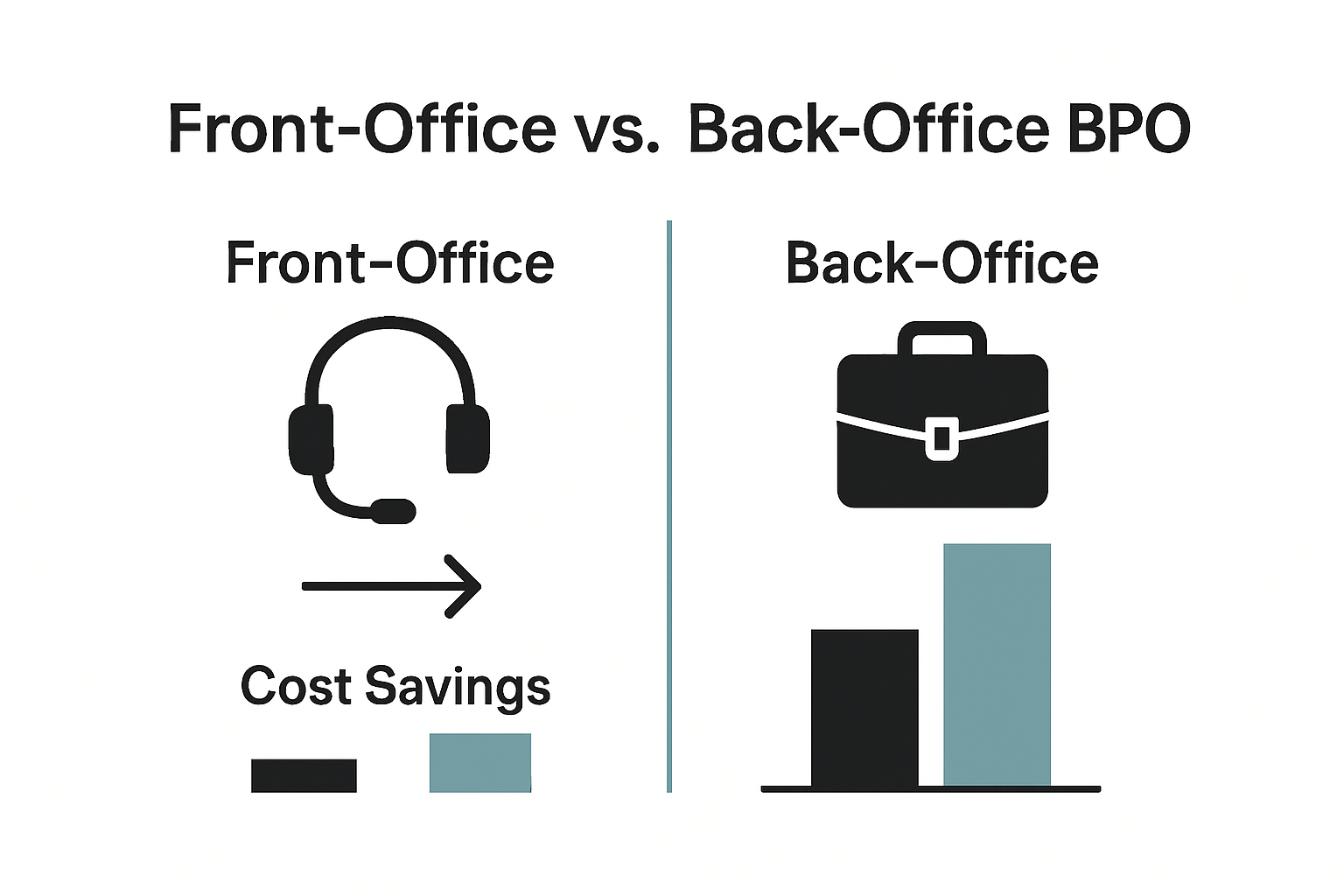
Research from ijrar.org further categorizes BPO services into two fundamental operational types: front-office and back-office operations. Front-office BPO typically involves customer-facing services like technical support, sales, and customer relationship management. Back-office BPO encompasses internal business functions such as human resources, accounting, payment processing, and administrative support.
Enterprise-level organizations often leverage multiple BPO models simultaneously, creating hybrid approaches that maximize operational efficiency and strategic flexibility.
 For instance, a company might use offshore providers for cost-intensive technical support while maintaining nearshore teams for more complex, culturally sensitive customer interactions.
Understanding these varied BPO models allows businesses to design tailored outsourcing strategies.
7 Essential Examples of BPO Services for Enterprises can provide deeper insights into how different organizations implement these diverse outsourcing approaches effectively.
Major Benefits for Medium and Large Enterprises
Business Process Outsourcing (BPO) offers transformative advantages for medium and large enterprises seeking strategic operational improvements. According to research from saveoursavings.org, organizations can achieve substantial cost reductions and enhanced operational efficiency through targeted outsourcing strategies.
The key benefits for enterprises include:
- Significant Cost Optimization: Reducing operational expenses by 30-60% compared to traditional in-house models
- Access to Global Talent: Leveraging specialized skills and expertise across diverse geographic regions
- Technology Infrastructure Enhancement: Gaining immediate access to advanced technological capabilities
- Scalable Operational Flexibility: Quickly adjusting workforce and resource allocation
- Focus on Core Business Strategies: Redirecting internal resources toward primary business objectives
Research from techjournal.org highlights that BPO services provide enterprises with critical competitive advantages.
 By outsourcing non-core functions, organizations can create more agile and responsive business models that adapt quickly to market changes and technological disruptions.
Enterprise-level BPO implementation goes beyond simple cost-cutting. It represents a strategic approach to organizational transformation, enabling companies to build more efficient, technologically advanced, and globally competitive operational frameworks. The ability to access specialized skills, reduce administrative overhead, and maintain high-performance standards makes BPO an increasingly attractive option for forward-thinking businesses.
For enterprises contemplating BPO integration, understanding the nuanced benefits is crucial. 7 Key Advantages of BPO Services for Modern Enterprises can provide additional insights into how strategic outsourcing can drive substantial organizational growth and innovation.
Real-World Applications Across Industries
Business Process Outsourcing (BPO) has transformed operational strategies across diverse industry sectors, enabling organizations to optimize performance and drive innovation. According to research from ideas.repec.org, technological advancements have significantly enhanced the quality and efficiency of BPO implementations across multiple business domains.
Key Industry Applications include:
- Healthcare: Medical billing, patient record management, telemedicine support
- Finance: Accounting, payroll processing, customer service, fraud detection
- Technology: Software development, technical support, quality assurance testing
- Manufacturing: Supply chain management, inventory tracking, logistics coordination
- Telecommunications: Customer support, billing systems, network operations management
Research from macrothink.org highlights how BPO services enable organizations to create more dynamic and responsive operational models. The strategic implementation of BPO allows companies to focus on core competencies while leveraging specialized external expertise for complex administrative and technological functions.
Industry-specific BPO applications demonstrate remarkable versatility. For instance, in healthcare, BPO services streamline complex administrative processes, allowing medical professionals to concentrate on patient care. Financial institutions utilize BPO to enhance regulatory compliance, reduce operational costs, and improve customer experience through specialized support services.
For enterprises seeking deeper understanding of industry-specific BPO strategies, 7 Essential Examples of BPO Services for Enterprises provides comprehensive insights into practical implementation across various business sectors.
Addressing Risks, Costs, and Common Pitfalls
Navigating the complex landscape of Business Process Outsourcing (BPO) requires a strategic approach to mitigating potential risks and understanding associated challenges. According to research from ijcaonline.org, organizations must carefully evaluate the potential vulnerabilities inherent in remote and outsourced work models.
Key Risk Areas for BPO Implementation include:
- Data Security and Privacy Vulnerabilities
- Communication and Cultural Misalignment
- Quality Control Inconsistencies
- Operational Transparency Challenges
- Unexpected Hidden Costs
- Compliance and Regulatory Risks
Research from iipseries.org emphasizes the critical importance of employee retention and management strategies in mitigating BPO implementation risks. Successful organizations develop comprehensive frameworks that address potential operational disruptions, create clear communication protocols, and establish rigorous performance monitoring mechanisms.
Financial risks represent a significant consideration in BPO strategies. While outsourcing can generate substantial cost savings, enterprises must conduct thorough cost-benefit analyses that account for transition expenses, potential productivity disruptions, and long-term strategic alignment. Unexpected integration challenges can quickly erode anticipated financial benefits, making comprehensive due diligence essential.
For enterprises seeking to navigate these complex considerations, Managed BPO Services: Everything You Need to Know provides additional insights into developing robust, risk-mitigated BPO implementation strategies that protect organizational interests and maximize operational potential.
Unlock the Full Potential of Your Enterprise with Expert BPO Solutions
Businesses face real challenges when shifting to Business Process Outsourcing. You want to reduce costs while maintaining quality and security. You need scalable, flexible services that align with your strategic goals. The article highlights crucial pain points such as data security risks, operational transparency, and the need to access specialized global talent. At StorsenDigital.com, we understand these concerns and offer tailored managed BPO services that deliver efficiency, innovation, and peace of mind.
Why struggle with hidden costs and communication barriers when you can partner with a trusted provider? Our expertise in nearshoring across Europe ensures cultural alignment and seamless collaboration. We help you optimize HR, finance, IT, customer support, and software development functions so your enterprise can focus on core business growth. Explore how we transform challenges into competitive advantages with strategic consulting and proven project success.

Ready to accelerate your outsourcing journey with a partner who prioritizes your goals and security? Visit StorsenDigital.com today to discover customized BPO solutions designed for medium and large enterprises. Learn more about how managed BPO services can reduce your operational costs while enhancing flexibility. Empower your organization now by choosing the strategic BPO partner that delivers results.
Frequently Asked Questions
What are BPO services?
BPO services involve outsourcing specific business functions to external providers, allowing organizations to focus on core competencies while benefiting from specialized expertise and efficiencies.
What are the main types of BPO models?
The main types of BPO models include offshore outsourcing, nearshore outsourcing, and onshore outsourcing, as well as front-office and back-office operations.
What are the key benefits of using BPO services for enterprises?
Key benefits of BPO services for enterprises include significant cost optimization, access to global talent, enhanced technology infrastructure, scalable operational flexibility, and the ability to focus on core business strategies.
What risks should businesses consider when implementing BPO?
Businesses should consider risks such as data security vulnerabilities, communication challenges, quality control inconsistencies, hidden costs, and compliance risks when implementing BPO services.


