


American outsourcing models have set a high bar, but over 64 percent of European enterprises now turn to managed BPO services for smarter cost control and rapid talent access. With rising labor costs across the continent, leaders must rethink traditional hiring if they want to stay competitive. This guide reveals practical steps for evaluating your operations, choosing the right partners, and building measurable frameworks that deliver sustainable value without sacrificing quality or compliance.
Table of Contents
- Step 1: Assess Operational Needs And Define Scope
- Step 2: Select Partners And Set Service Standards
- Step 3: Implement Workflow Tools And Onboarding Processes
- Step 4: Monitor Service Delivery And Benchmarks
- Step 5: Verify Quality And Optimize Ongoing Performance
Quick Summary
| Key Message | Explanation |
|---|---|
| 1. Assess operational needs early | Begin by conducting a thorough analysis of your workflow to identify challenges and objectives. |
| 2. Select partners with proven synergy | Choose BPO partners based on their capabilities and alignment with your business culture and goals. |
| 3. Implement structured onboarding | Develop a comprehensive onboarding program to help new team members integrate smoothly and effectively. |
| 4. Monitor performance regularly | Establish real-time tracking of key performance indicators to address issues promptly and improve outcomes. |
| 5. Focus on quality and continuous improvement | Create a system for ongoing evaluation and adjustments based on performance metrics and feedback. |
Step 1: Assess operational needs and define scope
Successfully mapping out your workflow for managed BPO services starts with a comprehensive assessment of your current operational landscape. In this critical first phase, you will systematically analyze your organization’s specific requirements, challenges, and strategic objectives to create a precise service delivery framework.
Begin by conducting a detailed operational needs analysis using established workflow patterns that examine your control flows, resource management, and data interactions. This involves gathering input from key stakeholders across departments to understand existing processes, pain points, and desired outcomes. Focus on mapping current workflows, identifying bottlenecks, and determining specific areas where managed BPO services can deliver tangible improvements. Consider aspects like process efficiency, scalability, cost reduction, and potential technological integrations.
As you progress through this assessment, aim to develop a clear and measurable scope that aligns with your organization’s broader strategic goals. Establishing well defined objectives connects directly to effective risk management and governance ensuring that your BPO engagement delivers meaningful value. Document your findings comprehensively, creating a roadmap that outlines specific service requirements, expected performance metrics, and anticipated outcomes.
Pro Tip: Involve cross functional teams during the initial assessment to gain holistic insights and ensure your defined scope represents a comprehensive organizational perspective.
Step 2: Select partners and set service standards
Selecting the right BPO partners and establishing clear service standards is crucial for ensuring successful workflow optimization and delivering predictable, high quality outcomes. This step transforms your operational strategy from theoretical planning into practical implementation.

Begin by conducting a thorough evaluation of potential partners through a comprehensive business process outsourcing assessment that examines their technical capabilities, cultural alignment, and proven track record. Look beyond basic cost considerations and focus on partners who demonstrate robust governance structures, flexible service models, and a commitment to continuous improvement. Develop a detailed request for proposal (RFP) that clearly outlines your specific service requirements, performance expectations, and key performance indicators (KPIs) that will guide your partnership.
As you progress, implement rigorous process governance frameworks that establish accountability, define compliance protocols, and create measurable performance standards. This involves drafting comprehensive service level agreements (SLAs) that specify precise metrics, response times, quality benchmarks, and remediation processes. Ensure these agreements include mechanisms for regular performance reviews, escalation procedures, and potential contract adjustments to maintain alignment with your evolving business needs.
Pro Tip: Create a balanced scorecard that tracks both quantitative performance metrics and qualitative partnership attributes to develop a holistic evaluation approach.
Step 3: Implement workflow tools and onboarding processes
Successfully implementing workflow tools and developing robust onboarding processes are critical for transforming your managed BPO service strategy into a seamless operational reality. This step focuses on creating systematic approaches that integrate new team members efficiently and optimize your overall service delivery mechanism.
Begin by exploring comprehensive onboarding methodologies that involve collaborative engagement between HR, management, and supervisory teams. Design a structured onboarding program that starts with pre-joining communication, includes comprehensive orientation modules, and establishes continuous feedback mechanisms. Develop digital documentation, training resources, and clear role expectations that help new team members understand their responsibilities and integrate quickly into your organizational ecosystem.
Next, implement advanced workflow management tools and digital process mapping techniques that enable real time performance tracking and continuous improvement. Select workflow platforms that offer intuitive interfaces, robust reporting capabilities, and seamless integration with existing systems. Ensure these tools provide visibility into individual and team performance, allow for easy communication, and support agile adjustments to your service delivery models. Create standard operating procedures that are flexible yet comprehensive, enabling your team to maintain high performance standards while adapting to evolving business requirements.
Pro Tip: Develop a mentorship program alongside your digital onboarding processes to provide new team members with personalized guidance and accelerate their professional integration.
Step 4: Monitor service delivery and benchmarks
Monitoring service delivery and establishing meaningful benchmarks is essential for maintaining high performance and driving continuous improvement in your managed BPO operations. This critical step transforms raw performance data into actionable insights that guide strategic decision making and operational excellence.
Begin by implementing comprehensive benchmarking frameworks that enable objective measurement of your service performance against industry standards. Develop a robust set of key performance indicators (KPIs) that capture both quantitative metrics and qualitative outcomes. These should include dimensions such as response times, error rates, customer satisfaction scores, cost efficiency, and process completion rates. Utilize validated data collection methods that provide clear visibility into your team’s performance and allow for meaningful comparative analysis with industry peers.
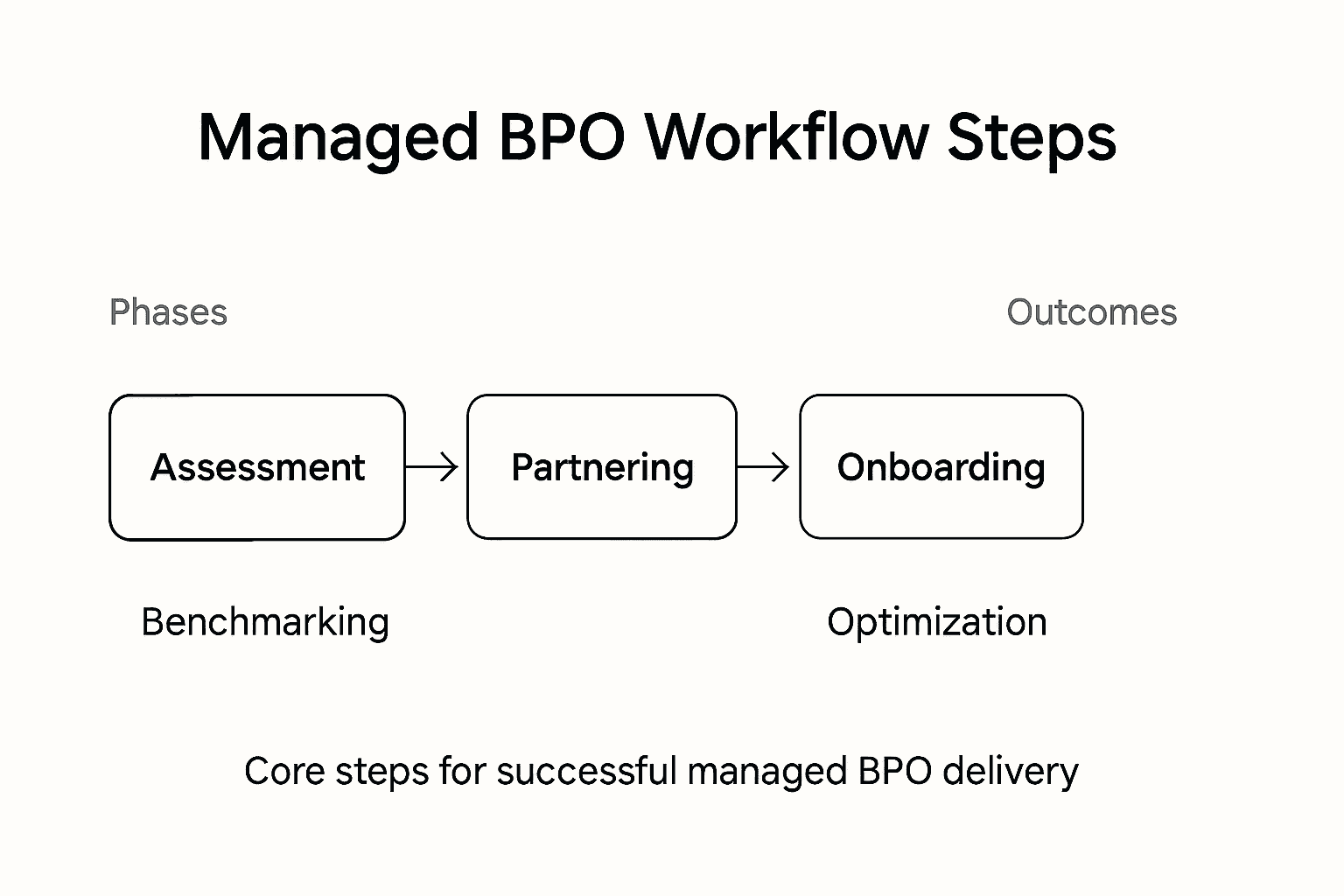
Progress to systematic monitoring of key performance indicators that enable real time tracking and proactive management of service delivery quality. Create dashboards that provide immediate insights into performance trends, potential bottlenecks, and areas requiring immediate attention. Implement regular review cycles where you analyze these metrics, identify improvement opportunities, and develop targeted strategies to address any performance gaps. Ensure your monitoring approach is dynamic, allowing for rapid adjustments and continuous refinement of your service delivery model.
Pro Tip: Establish a quarterly cross functional review process that brings together leadership from operations, client management, and quality assurance to comprehensively evaluate performance metrics and alignment with strategic objectives.
Step 5: Verify quality and optimize ongoing performance
Verifying quality and continuously optimizing performance are essential final steps in creating a world class managed BPO service strategy. This phase transforms your operational framework from a static model into a dynamic system of perpetual improvement and strategic refinement.
Begin by implementing rigorous performance verification frameworks that assess your service delivery against predefined quality standards. Develop comprehensive risk assessment protocols that systematically evaluate each aspect of your operational process. This involves creating detailed checklists, conducting regular audits, and establishing clear metrics that measure not just outcomes but also the effectiveness of your underlying processes. Focus on identifying potential vulnerabilities, measuring performance deviations, and creating responsive mechanisms for immediate corrective action.
Progress to implementing continuous improvement methodologies based on established quality management principles like the Plan-Do-Check-Act (PDCA) cycle. Create a culture of ongoing optimization where data driven insights trigger proactive adjustments. Design feedback loops that connect performance metrics directly to strategic planning, allowing your organization to rapidly adapt to changing client needs and market dynamics. Ensure your quality verification process is transparent, collaborative, and aligned with your broader organizational objectives.
Pro Tip: Develop a standardized incident reporting and resolution system that transforms quality challenges into opportunities for systemic improvement and organizational learning.
The table below contrasts quantitative and qualitative metrics for managed BPO service evaluation:
| Metric Type | Example KPI | Value to Organization |
|---|---|---|
| Quantitative | Process error rate (%) | Highlights operational accuracy |
| Quantitative | Response time (minutes) | Measures efficiency |
| Qualitative | Client satisfaction survey | Reveals service strengths/weakness |
| Qualitative | Team collaboration feedback | Identifies integration challenges |
Here’s a summary of key managed BPO workflow success factors at each implementation stage:
| Implementation Step | Primary Success Factor | Business Impact |
|---|---|---|
| Assess Needs | Cross-functional input | Ensures holistic requirements |
| Select Partners | Structured RFP and scoring | Improves partner alignment |
| Onboarding Processes | Digital training modules | Accelerates team integration |
| Monitor Delivery | Real-time KPI dashboards | Enables rapid issue resolution |
| Optimize Quality | Continuous feedback loops | Drives ongoing performance gains |
Elevate Your Managed BPO Workflow with Expert Partnership
Optimizing your managed BPO services means tackling complex challenges like precise workflow mapping, rigorous quality verification, and continuous performance improvement. If you are striving to overcome bottlenecks and ensure seamless service delivery with measurable KPIs, these are the same critical focus areas where StorsenDigital excels. Our expertise in tailored outsourcing solutions across Europe empowers your business to scale operations efficiently while maintaining robust compliance and governance frameworks.
By leveraging our comprehensive managed BPO offerings including HR, finance, IT, and customer support, you gain access to proven onboarding processes, advanced workflow management tools, and data-driven performance monitoring. This holistic approach transforms your operational strategy into a dynamic system of ongoing optimization that aligns directly with your organizational goals.
Discover how StorsenDigital can help you build a resilient, value-driven BPO workflow today.
Take the next step toward operational excellence and unlock the full potential of your managed BPO partnership by contacting us now at StorsenDigital Contact.

Partner with us to reduce costs, accelerate talent integration, and enhance service quality. Reach out to start transforming your outsourcing strategy today.
Frequently Asked Questions
What are the first steps in assessing operational needs for managed BPO services?
Begin by conducting a comprehensive operational needs analysis. Gather input from stakeholders across departments to identify existing processes, challenges, and desired outcomes, ensuring you create a service delivery framework that meets your organization’s specific requirements.
How do I select the right BPO partners for my workflow optimization?
To select BPO partners effectively, evaluate potential candidates based on their technical capabilities, cultural alignment, and governance structures. Create a detailed request for proposal (RFP) outlining your specific service needs and performance expectations to guide your selection process.
What should be included in service level agreements for managed BPO services?
Service level agreements (SLAs) should clearly define performance metrics, response times, quality benchmarks, and remediation processes. Ensure they also include mechanisms for regular performance reviews and adjustments based on your evolving business needs.
How can I effectively monitor the performance of my managed BPO services?
To monitor performance, implement key performance indicators (KPIs) that capture both quantitative metrics, such as response times and error rates, and qualitative outcomes, like customer satisfaction. Use dashboards for real-time tracking and establish regular review cycles to evaluate these metrics and identify improvement opportunities.
What are effective strategies for onboarding new team members in managed BPO?
Develop a structured onboarding program that includes pre-joining communication and comprehensive orientation modules. Incorporate digital documentation and training resources to help new team members integrate quickly into your organizational ecosystem.
How can continuous improvement be achieved in managed BPO operations?
Continuous improvement can be achieved by implementing feedback loops that connect performance metrics to strategic planning. Focus on creating a culture of ongoing optimization where data-driven insights trigger proactive adjustments to your BPO service delivery model.


